Christoph Feichtenhofer
Director, Research Scientist
Meta Superintelligence Labs
feichtenhofer _at_ meta.com

Recent technical reports · Google Scholar


SAM 3: Segment Anything with Concepts
Nicolas Carion, Laura Gustafson, Yuan-Ting Hu, Shoubhik Debnath, Ronghang Hu, Didac Suris, Chaitanya Ryali, Kalyan Vasudev Alwala, Haitham Khedr, Andrew Huang, Jie Lei, Tengyu Ma, Baishan Guo, Arpit Kalla, Markus Marks, Joseph Greer, Meng Wang, Peize Sun, Roman Radle, Triantafyllos Afouras, Effrosyni Mavroudi, Katherine Xu, Tsung-Han Wu, Yu Zhou, Liliane Momeni, Rishi Hazra, Shuangrui Ding, Sagar Vaze, Francois Porcher, Feng Li, Siyuan Li, Aishwarya Kamath, Ho Kei Cheng, Piotr Dollar, Nikhila Ravi, Kate Saenko, Pengchuan Zhang, Christoph Feichtenhofer
International Conference on Learning Representations (ICLR) 2026
We present Segment Anything Model (SAM) 3, a unified model that detects, segments, and tracks objects in images and videos based on concept prompts, which we define as either short noun phrases (e.g., “yellow school bus”), image exemplars, or a combination of both. Promptable Concept Segmentation (PCS) takes such prompts and returns segmentation masks and unique identities for all matching object instances. To advance PCS, we build a scalable data engine that produces a high-quality dataset with 4M unique concept labels, including hard negatives, across images and videos. Our model consists of an image-level detector and a memory-based video tracker that share a single backbone. Recognition and localization are decoupled with a presence head, which boosts detection accuracy. SAM 3 delivers a 2× gain over existing systems in both image and video PCS, and improves previous SAM capabilities on visual segmentation tasks. We open source SAM 3 along with our new Segment Anything with Concepts (SA-Co) benchmark for promptable concept segmentation.


SAM Audio: Segment Anything in Audio
Bowen Shi, Andros Tjandra, John Hoffman†, Helin Wang, Yi-Chiao Wu, Luya Gao, Julius Richter, Matt Le, Apoorv Vyas, Sanyuan Chen, Christoph Feichtenhofer, Piotr Dollár, Wei-Ning Hsu, Ann Lee
International Conference on Machine Learning (ICML) 2026
General audio source separation is a key capability for multimodal AI systems that can perceive and reason about sound. Despite substantial progress in recent years, existing separation models are either domain-specific, designed for fixed categories such as speech or music, or limited in controllability, supporting only a single prompting modality such as text. In this work, we present SAM Audio, a foundation model for general audio separation that unifies text, visual, and temporal span prompting within a single framework. Built on a diffusion transformer architecture, SAM Audio is trained with flow matching on large-scale audio data spanning speech, music, and general sounds, and can flexibly separate target sources described by language, visual masks, or temporal spans. The model achieves state-of-the-art performance across a diverse suite of benchmarks, including general sound, speech, music, and musical instrument separation in both in-the-wild and professionally produced audios, substantially outperforming prior general-purpose and specialized systems. Furthermore, we introduce a new real-world separation benchmark with human-labeled multimodal prompts and a reference-free evaluation model that correlates strongly with human judgment.


Pushing the Frontier of Audiovisual Perception with Large-Scale Multimodal Correspondence Learning
Apoorv Vyas, Heng-Jui Chang, Cheng-Fu Yang, Po-Yao Huang, Luya Gao, Julius Richter, Sanyuan Chen, Matt Le, Piotr Dollár, Christoph Feichtenhofer, Ann Lee, Wei-Ning Hsu
Conference on Computer Vision and Pattern Recognition (CVPR) 2026
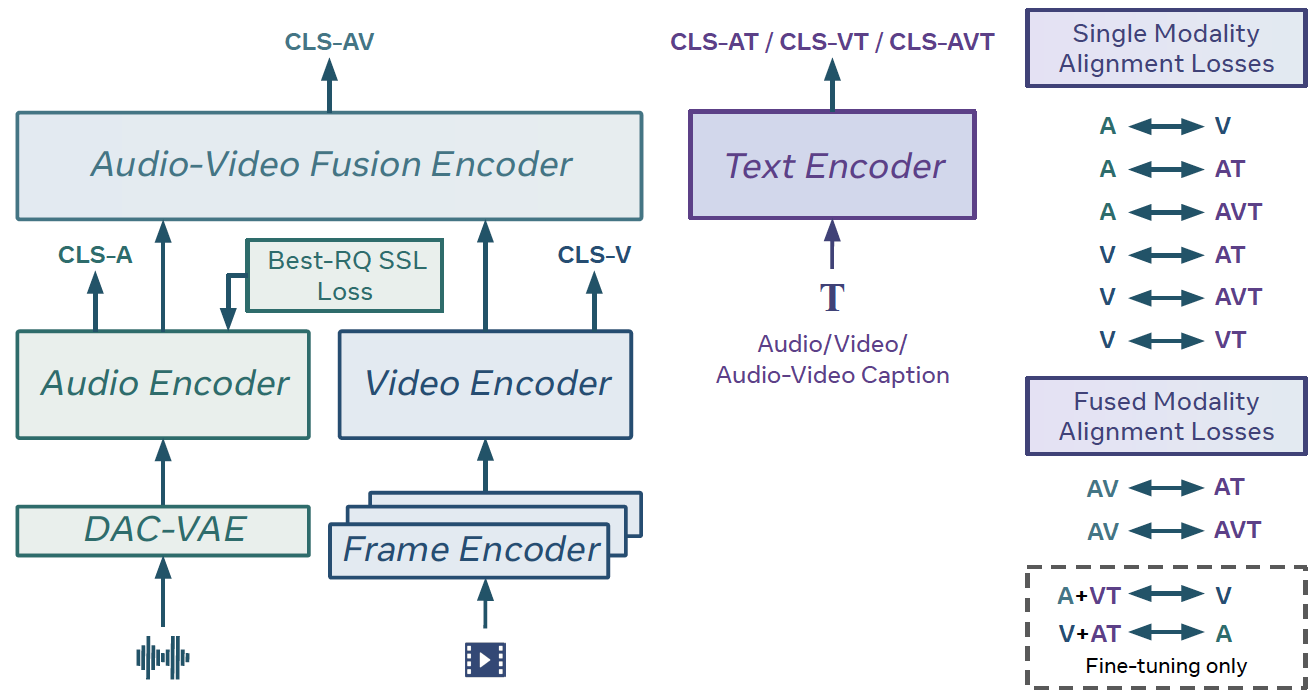
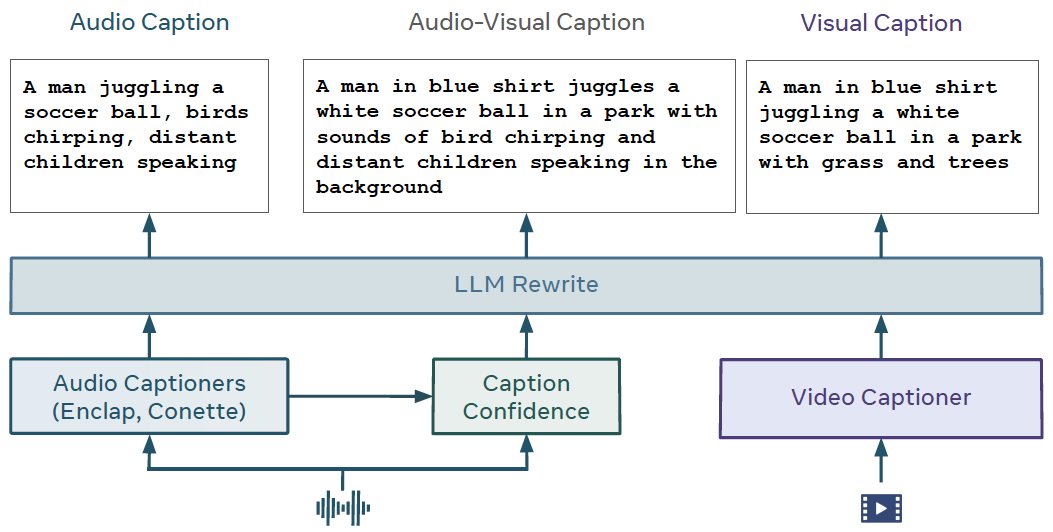
We introduce Perception Encoder Audiovisual, PE-AV, a new family of encoders for audio and video understanding trained with scaled contrastive learning. Built on PE, PE-AV makes several key contributions to extend representations to audio, and natively support joint embeddings across audio-video, audio-text, and video-text modalities. PE-AV's unified cross-modal embeddings enable novel tasks such as speech retrieval, and set a new state of the art across standard audio and video benchmarks. We unlock this by building a strong audiovisual data engine that synthesizes high-quality captions for O(100M) audio-video pairs, enabling large-scale supervision consistent across modalities. Our audio data includes speech, music, and general sound effects-avoiding single-domain limitations common in prior work. We exploit ten pairwise contrastive objectives, showing that scaling cross-modality and caption-type pairs strengthens alignment and improves zero-shot performance. We further develop PE-A-Frame by fine-tuning PE-AV with frame-level contrastive objectives, enabling fine-grained audio-frame-to-text alignment for tasks such as sound event detection.


Perception Encoder: The best visual embeddings are not at the output of the network
Daniel Bolya, Po-Yao Huang, Peize Sun, Jang Hyun Cho, Andrea Madotto, Chen Wei, Tengyu Ma, Jiale Zhi, Jathushan Rajasegaran, Hanoona Rasheed, Junke Wang, Marco Monteiro, Hu Xu, Shiyu Dong, Nikhila Ravi, Daniel Li, Piotr Dollár, Christoph Feichtenhofer
Advances in Neural Information Processing Systems (NeurIPS) 2025, Oral
We introduce Perception Encoder (PE), a state-of-the-art encoder for image and video understanding trained via simple vision-language learning. Traditionally, vision encoders have relied on a variety of pretraining objectives, each tailored to specific downstream tasks such as classification, captioning, or localization. Surprisingly, after scaling our carefully tuned image pretraining recipe and refining with our robust video data engine, we find that contrastive vision-language training alone can produce strong, general embeddings for all of these downstream tasks. There is only one caveat: these embeddings are hidden within the intermediate layers of the network. To draw them out, we introduce two alignment methods, language alignment for multimodal language modeling, and spatial alignment for dense prediction. Together with the core contrastive checkpoint, our PE family of models achieves state-of-the-art performance on a wide variety of tasks, including zero-shot image and video classification and retrieval; document, image, and video Q&A; and spatial tasks such as detection, depth estimation, and tracking. To foster further research, we are releasing our models, code, and a novel dataset of synthetically and human-annotated videos.

PerceptionLM: Open-Access Data and Models for Detailed Visual Understanding
Jang Hyun Cho, Andrea Madotto, Effrosyni Mavroudi, Triantafyllos Afouras, Tushar Nagarajan, Muhammad Maaz, Yale Song, Tengyu Ma, Shuming Hu, Suyog Jain, Miguel Martin, Huiyu Wang, Hanoona Rasheed, Peize Sun, Po-Yao Huang, Daniel Bolya, Nikhila Ravi, Shashank Jain, Tammy Stark, Shane Moon, Babak Damavandi, Vivian Lee, Andrew Westbury, Salman Khan, Philipp Krähenbühl, Piotr Dollár, Lorenzo Torresani, Kristen Grauman, Christoph Feichtenhofer
Advances in Neural Information Processing Systems (NeurIPS) 2025, Spotlight
Vision-language models are integral to computer vision research, yet many high-performing models remain closed-source, obscuring their data, design and training recipe. The research community has responded by using distillation from black-box models to label training data, achieving strong benchmark results, at the cost of measurable scientific progress. However, without knowing the details of the teacher model and its data sources, scientific progress remains difficult to measure. In this paper, we study building a Perception Language Model (PLM) in a fully open and reproducible framework for transparent research in image and video understanding. We analyze standard training pipelines without distillation from proprietary models and explore large-scale synthetic data to identify critical data gaps, particularly in detailed video understanding. To bridge these gaps, we release 2.8M human-labeled instances of fine-grained video question-answer pairs and spatio-temporally grounded video captions. Additionally, we introduce PLM–VideoBench, a suite for evaluating challenging video understanding tasks focusing on the ability to reason about "what", "where", "when", and "how" of a video. We make our work fully reproducible by providing data, training recipes, code & models.

News & Highlights

We released SAM 3. Models and benchmark are available. Try SAM 3 here.
I am a Lead Area Chair for CVPR 2026, Senior AC for ECCV 2026 and Area Chair for ICLR, ICML & NeurIPS 2026
I am a Lead Area Chair for CVPR & ICCV 2025 and Area Chair for ICLR & NeurIPS 2025
At ECCV 2024, I am speaker and panelist at the Visual object tracking and segmentation challenge VOTS2024 workshop, a speaker at the OmniLabel Workshop, and a Mentor at the Doctoral Consortium
We released SAM 2 and Llama 3. Models and code are available. Check out the demo for SAM 2
At CVPR 2024, I am speaker and panelist at the workshop on Computer Vision with Humans in the Loop, a speaker at the Efficient Large Vision Models workshop and a Mentor at the Doctoral Consortium
I am honored to have received the PAMI Young Researcher Award 2023
We organized a Video AI Symposium at DeepMind London
I am a Senior Area Chair for ECCV 2024, Area Chair for CVPR and ICLR 2024
At ICCV 2023, we organize a tutorial on Self-Supervised Representation Learning in Computer Vision and I am an invited speaker at the New Ideas in Vision Transformers Workshop
1/1, 3/3 and 1/1 submissions accepted to ICML, ICCV, and NeurIPS 2023
I am an Area Chair for CVPR, ICCV, BMVC and NeurIPS in 2023
At ECCV 2022, we organize a tutorial on Self-Supervised Representation Learning in Computer Vision, I am an invited speaker at the Ego4D Workshop and a Mentor at the LatinX in CV Workshop.
2/2 submissions accepted to NeurIPS 2022 and I will serve as an Area Chair for BMVC 2022
7/7 submissions accepted to CVPR 2022 and I will serve as an Area Chair for ECCV 2022
We released PyTorchVideo - a deep learning library for video research and applications
I will serve as an Area Chair of CVPR 2021 and BMVC 2021
We organized a tutorial on Visual Recognition for Images, Video, and 3D at ECCV 2020
We organized a tutorial on Images, Video, and 3D research and code at ICCV 2019
PySlowFast has been released! A codebase supporting video research and applications in PyTorch
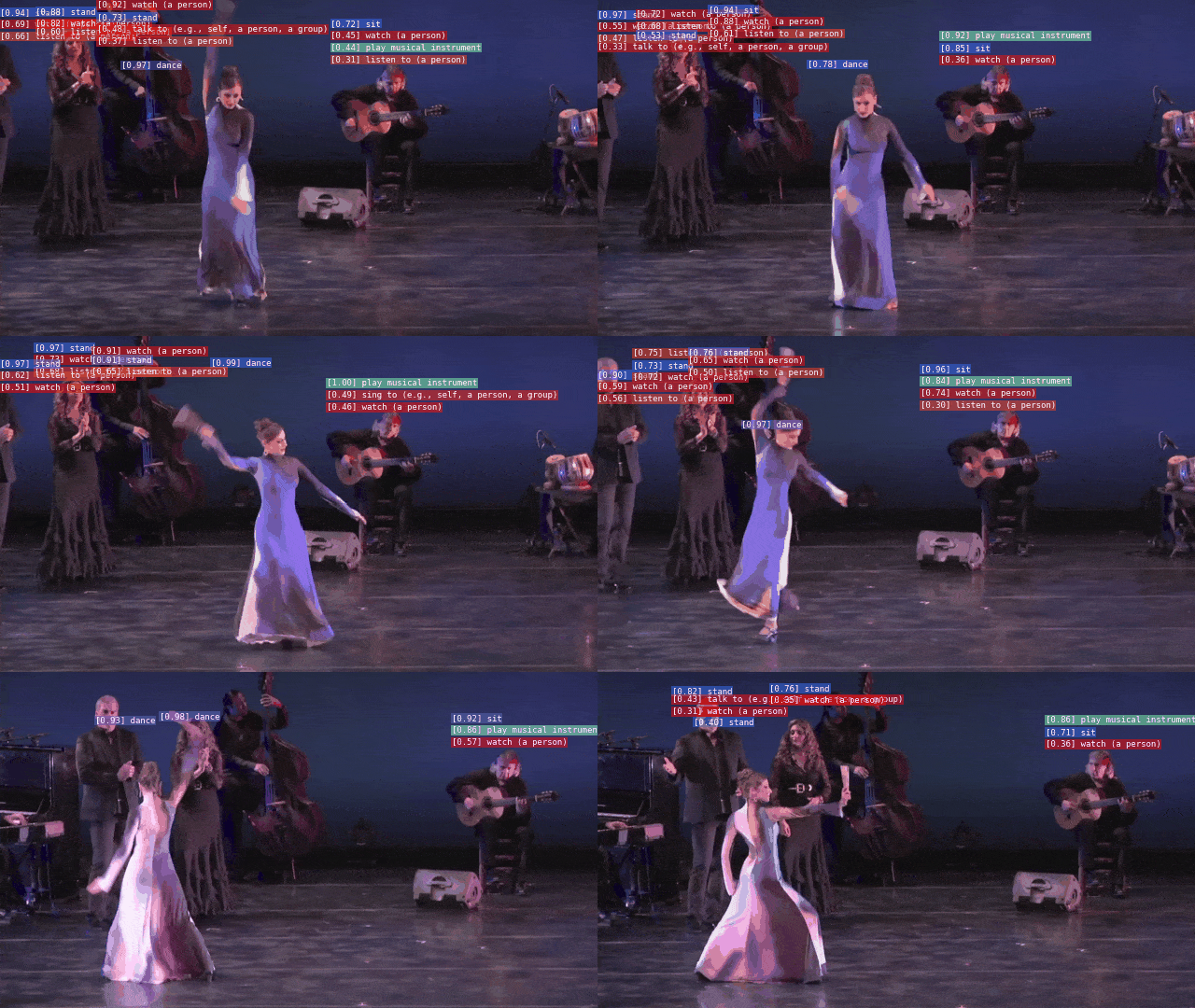
Our entry based on SlowFast achieved 34.3 mAP which corresponds to a gain of 13 mAP over the winning solution of 2018. AVA Challenge report
The top 3 ranking teams all used SlowFast networks as backbone
We organized a tutorial on Visual Recognition at CVPR 2019
We organized a tutorial on Action Classification and Video Modelling at CVPR 2019
We organized a tutorial on Visual Recognition at ECCV 2018

Timeline

2021 -
Research Scientist, Director at Meta
Meta Superintelligence Labs, San Francisco, USA
2018 - 2021
Research Scientist at Facebook
Facebook AI Research (FAIR), Menlo Park, USA
2015 - 2018
Visiting Researcher at University of Oxford
Worked with Prof. Andrew Zisserman
Visual Geometry Group (VGG), Oxford, UK
2017 - 2018
PostDoc at TU Graz
Institute of Electrical Measurement and Sensor Systems (EMS), Graz, Austria
2014 - 2017
Visiting Researcher at York University
Worked with Prof. Richard P. Wildes
YorkU Vision Lab, Toronto, Canada
2014 - 2017
TU Graz: PhD
Thesis: Deep Learning for Video Recognition
2013
Visiting Researcher at York University
Worked with Prof. Richard P. Wildes
YorkU Vision Lab, Toronto, Canada

Publications · Google Scholar

SAM 2: Segment Anything in Images and Videos
Nikhila Ravi, Valentin Gabeur, Yuan-Ting Hu, Ronghang Hu, Chaitanya Ryali, Tengyu Ma, Haitham Khedr, Roman Rädle, Chloe Rolland, Laura Gustafson, Eric Mintun, Junting Pan, Kalyan Vasudev Alwala, Nicolas Carion, Chao-Yuan Wu, Ross Girshick, Piotr Dollár, Christoph Feichtenhofer
International Conference on Learning Representations (ICLR) 2025, Oral
Best Paper Honorable Mention Award
We present Segment Anything Model 2 (SAM 2), a foundation model towards solving promptable visual segmentation in images and videos. We build a data engine, which improves model and data via user interaction, to collect the largest video segmentation dataset to date. Our model is a simple transformer architecture with streaming memory for real-time video processing. SAM 2 trained on our data provides strong performance across a wide range of tasks. In video segmentation, we observe better accuracy, using 3x fewer interactions than prior approaches. In image segmentation, our model is more accurate and 6x faster than the Segment Anything Model (SAM). We believe that our data, model, and insights will serve as a significant milestone for video segmentation and related perception tasks. We are releasing a version of our model, the dataset and an interactive demo.


An empirical study of autoregressive pre-training from videos
Jathushan Rajasegaran, Ilija Radosavovic, Rahul Ravishankar, Yossi Gandelsman, Christoph Feichtenhofer, Jitendra Malik
International Conference on Computer Vision (ICCV) 2025
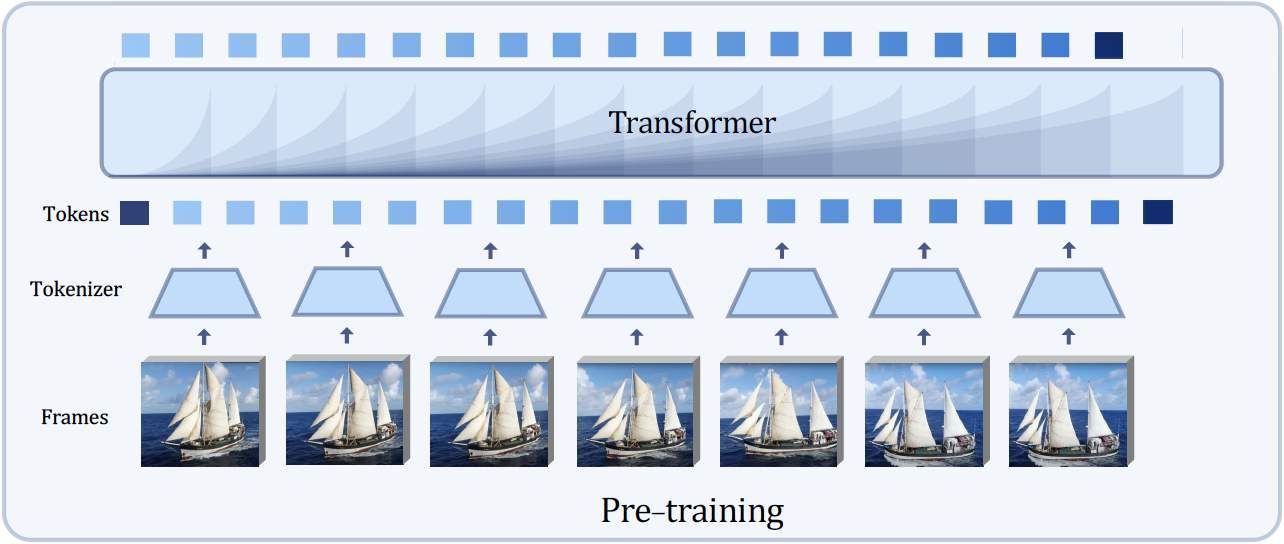
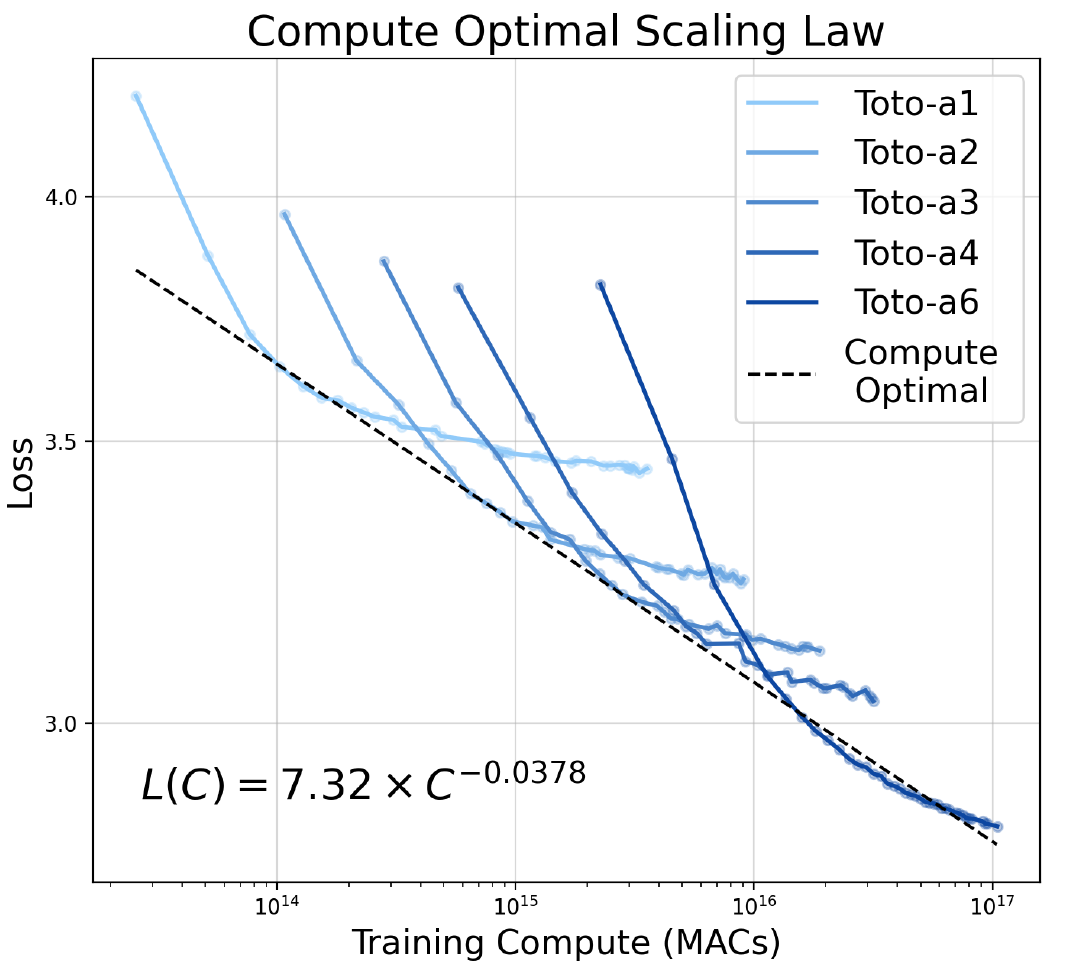
We empirically study autoregressive pre-training from videos. To perform our study, we construct a series of autoregressive video models, called Toto. We treat videos as sequences of visual tokens and train transformer models to autoregressively predict future tokens. Our models are pre-trained on a diverse dataset of videos and images comprising over 1 trillion visual tokens. We explore different architectural, training, and inference design choices. We evaluate the learned visual representations on a range of downstream tasks including image recognition, video classification, object tracking, and robotics. Our results demonstrate that, despite minimal inductive biases, autoregressive pre-training leads to competitive performance across all benchmarks. Finally, we find that scaling our video models results in similar scaling curves to those seen in language models, albeit with a different rate.

The Llama 3 Herd of Models
Llama team, Meta
Technical report, arXiv, July 2024
Modern artificial intelligence (AI) systems are powered by foundation models. This paper presents a new set of foundation models, called Llama 3. It is a herd of language models that natively support multilinguality, coding, reasoning, and tool usage. Our largest model is a dense Transformer with 405B parameters and a context window of up to 128K tokens. This paper presents an extensive empirical evaluation of Llama 3. We find that Llama 3 delivers comparable quality to leading language models such as GPT-4 on a plethora of tasks. We publicly release Llama 3, including pre-trained and post-trained versions of the 405B parameter language model and our Llama Guard 3 model for input and output safety. The paper also presents the results of experiments in which we integrate image, video, and speech capabilities into Llama 3 via a compositional approach. We observe this approach performs competitively with the state-of-the-art on image, video, and speech recognition tasks. The resulting models are not yet being broadly released as they are still under development.


Demystifying CLIP Data
Hu Xu, Saining Xie, Xiaoqing Ellen Tan, Po-Yao Huang, Russell Howes, Vasu Sharma, Shang-Wen Li, Gargi Ghosh, Luke Zettlemoyer, Christoph Feichtenhofer
International Conference on Learning Representations (ICLR) 2024, Spotlight
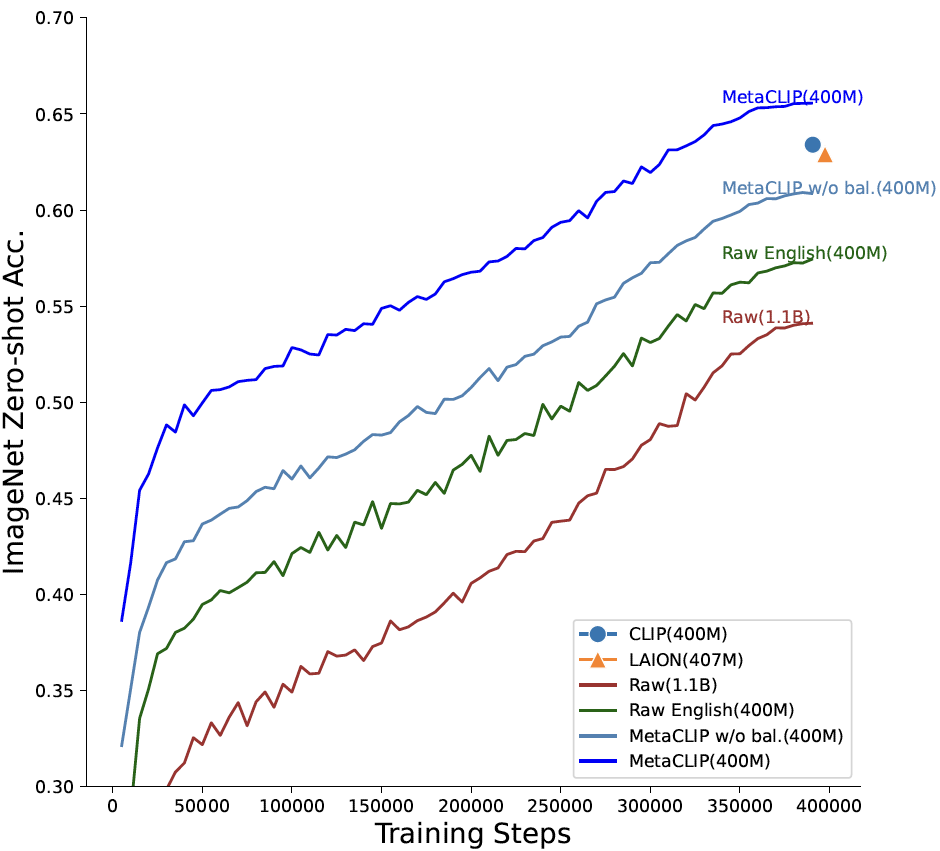
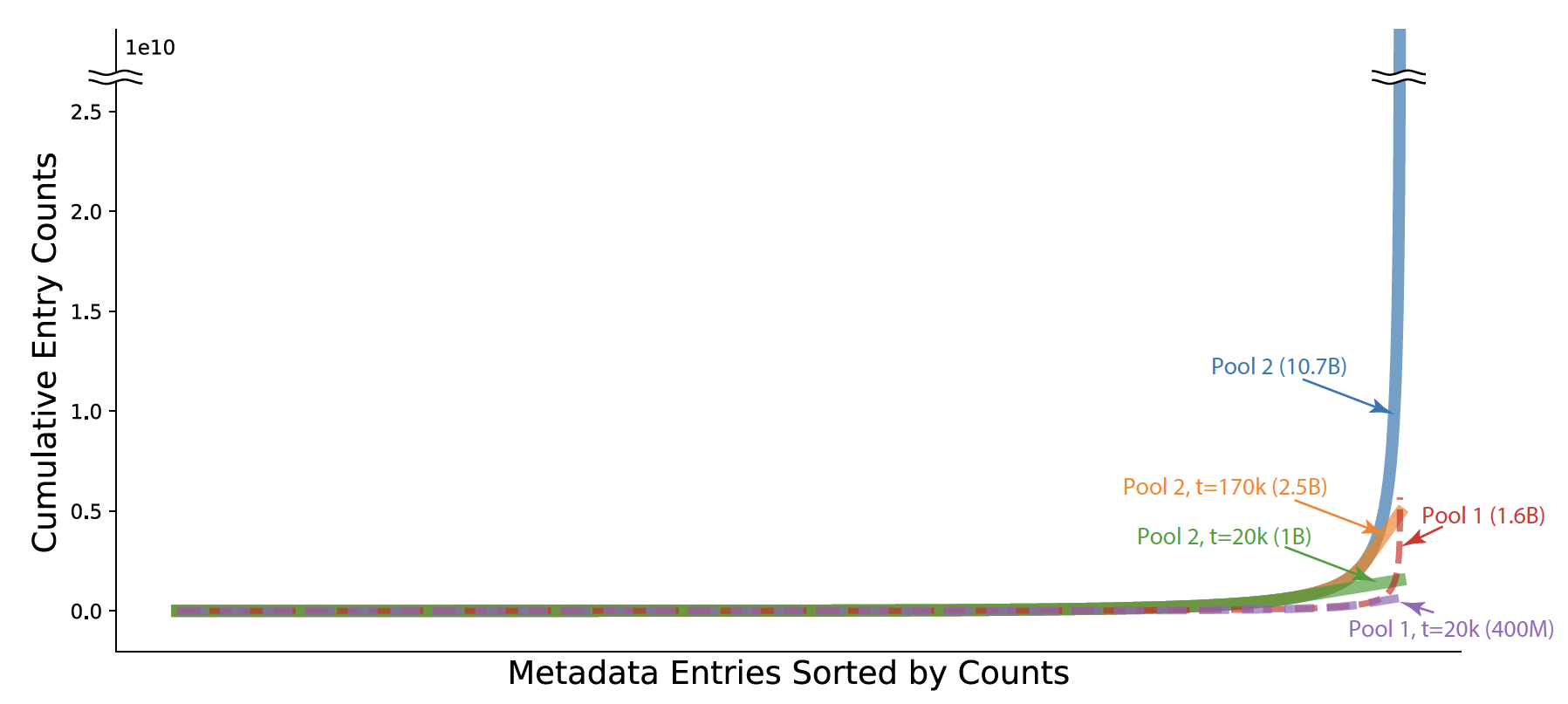
Contrastive Language-Image Pre-training (CLIP) is an approach that has advanced research and applications in computer vision, fueling modern recognition systems and generative models. We believe that the main ingredient to the success of CLIP is its data and not the model architecture or pre-training objective. However, CLIP only provides very limited information about its data and how it has been collected, leading to works that aim to reproduce CLIP's data by filtering with its model parameters. In this work, we intend to reveal CLIP's data curation approach and in our pursuit of making it open to the community introduce Metadata-Curated Language-Image Pre-training (MetaCLIP). MetaCLIP takes a raw data pool and metadata (derived from CLIP's concepts) and yields a balanced subset over the metadata distribution. Our experimental study rigorously isolates the model and training settings, concentrating solely on data. MetaCLIP applied to CommonCrawl with 400M image-text data pairs outperforms CLIP's data on multiple standard benchmarks. In zero-shot ImageNet classification, MetaCLIP achieves 70.8% accuracy, surpassing CLIP's 68.3% on ViT-B models. Scaling to 1B data, while maintaining the same training budget, attains 72.4%. Our observations hold across various model sizes, exemplified by ViT-H achieving 80.5%, without any bells-and-whistles.


Window Attention is Bugged: How not to Interpolate Position Embeddings
Daniel Bolya, Chaitanya Ryali, Judy Hoffman, Christoph Feichtenhofer
International Conference on Learning Representations (ICLR) 2024
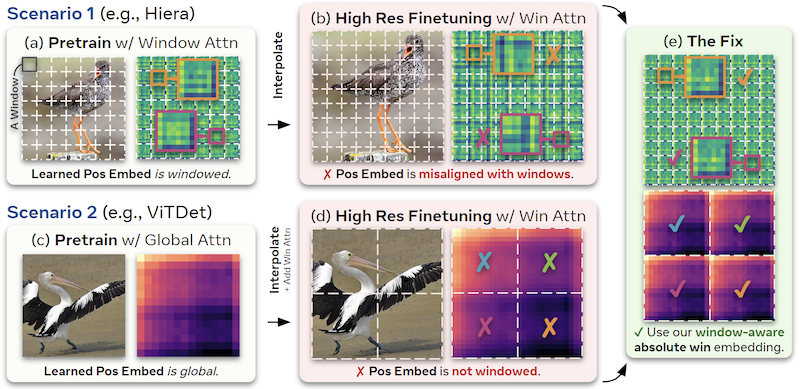
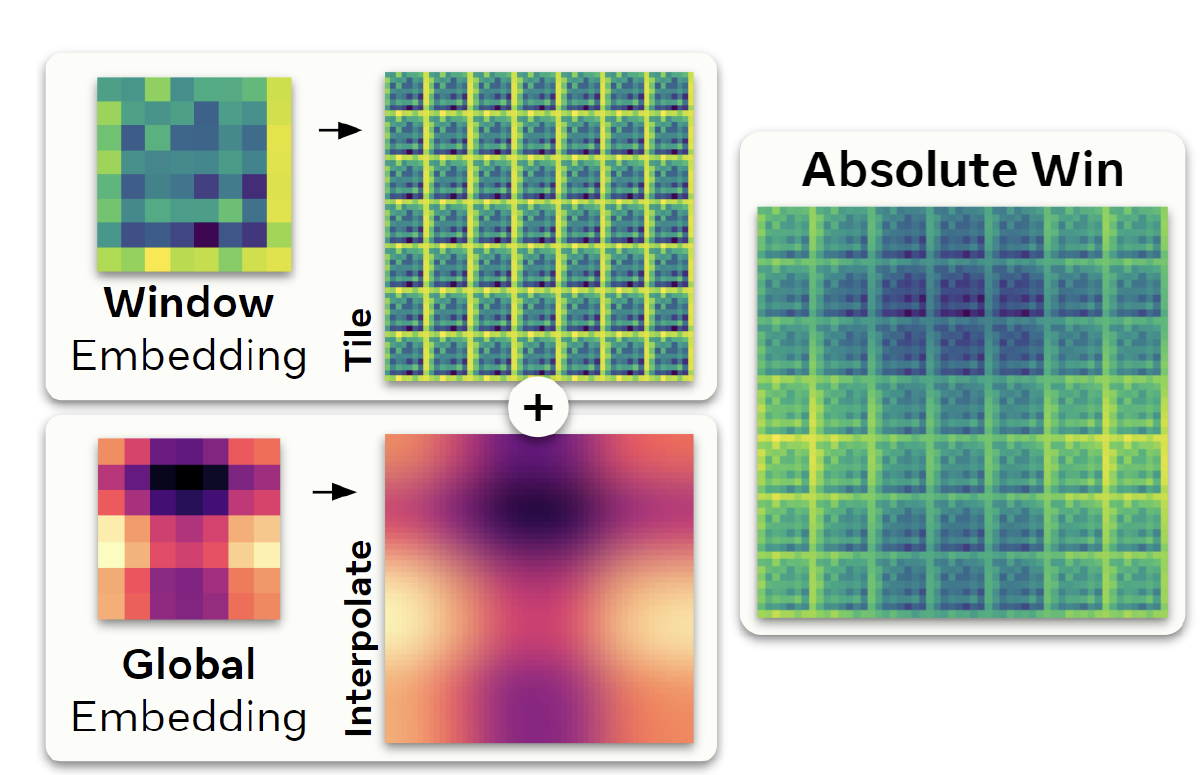
Window attention, position embeddings, and high resolution finetuning are core concepts in the modern transformer era of computer vision. However, we find that naively combining these near ubiquitous components can have a detrimental effect on performance. The issue is simple: interpolating position embeddings while using window attention is wrong. We study two state-of-the-art methods that have these three components, namely Hiera and ViTDet, and find that both do indeed suffer from this bug. To fix it, we introduce a simple absolute window position embedding strategy, which solves the bug outright in Hiera and allows us to increase both speed and performance of the model in ViTDet. We finally combine the two to obtain HieraDet, which achieves 61.7 box mAP on COCO, making it state-of-the-art for models that only use ImageNet-1k pretraining. This all stems from what is essentially a 3 line bug fix, which we name "absolute win".


Hiera: A Hierarchical Vision Transformer without the Bells-and-Whistles
Chaitanya Ryali*, Yuan-Ting Hu*, Daniel Bolya*, Chen Wei, Haoqi Fan, Po-Yao Huang, Vaibhav Aggarwal, Arkabandhu Chowdhury, Omid Poursaeed, Judy Hoffman, Jitendra Malik, Yanghao Li*, Christoph Feichtenhofer*
*equal contribution
International Conference on Machine Learning (ICML) 2023, Oral
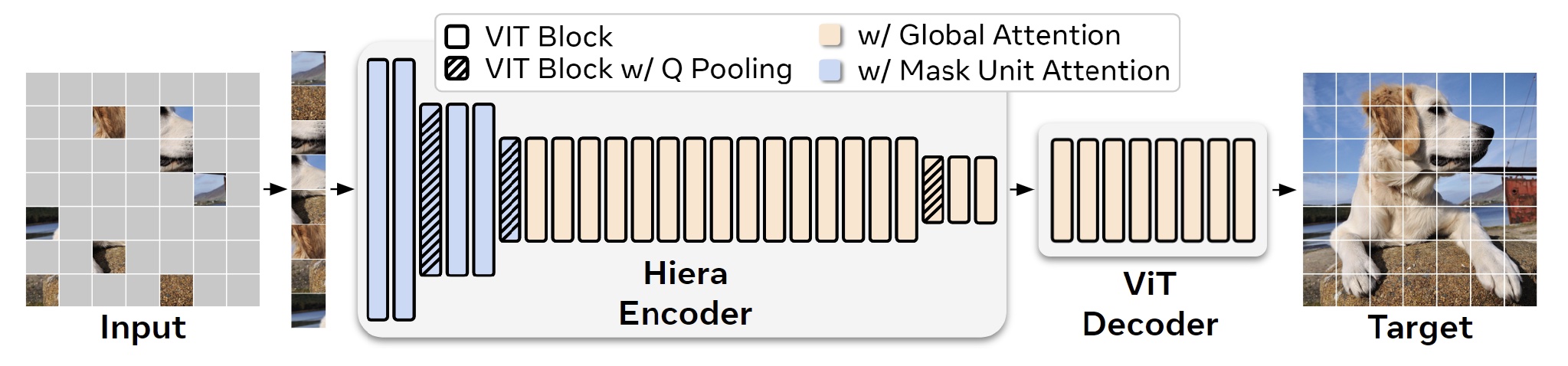
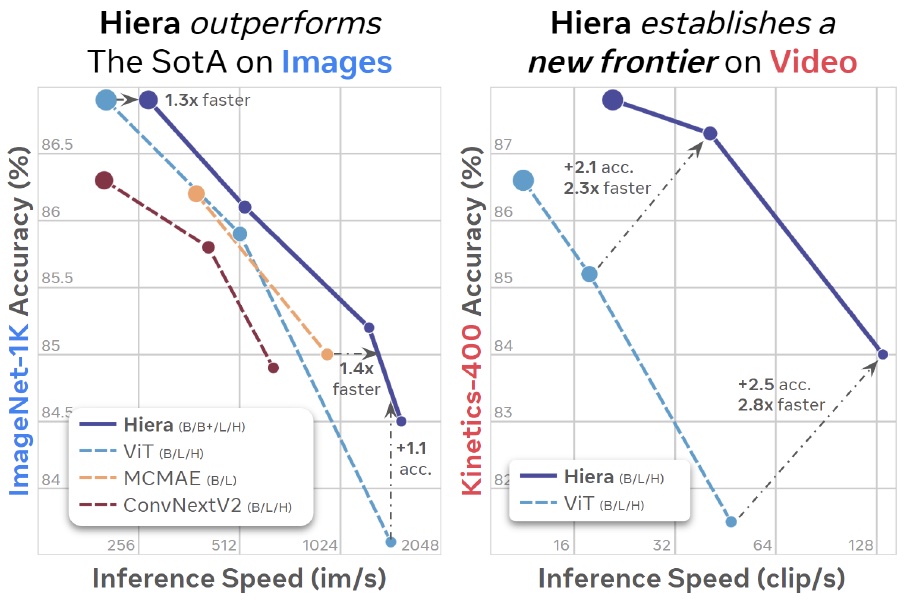
Modern hierarchical vision transformers have added several vision-specific components in the pursuit of supervised classification performance. While these components lead to effective accuracies and attractive FLOP counts, the added complexity actually makes these transformers slower than their vanilla ViT counterparts. In this paper, we argue that this additional bulk is unnecessary. By pretraining with a strong visual pretext task (MAE), we can strip out all the bells-and-whistles from a state-of-the-art multi-stage vision transformer without losing accuracy. In the process, we create Hiera, an extremely simple hierarchical vision transformer that is more accurate than previous models while being significantly faster both at inference and during training. We evaluate Hiera on a variety of tasks for image and video recognition.


MAViL: Masked Audio-Video Learners
Po-Yao Huang, Vasu Sharma, Hu Xu, Chaitanya Ryali, Haoqi Fan, Yanghao Li, Shang-Wen Li, Gargi Ghosh, Jitendra Malik, Christoph Feichtenhofer
Advances in Neural Information Processing Systems (NeurIPS) 2023
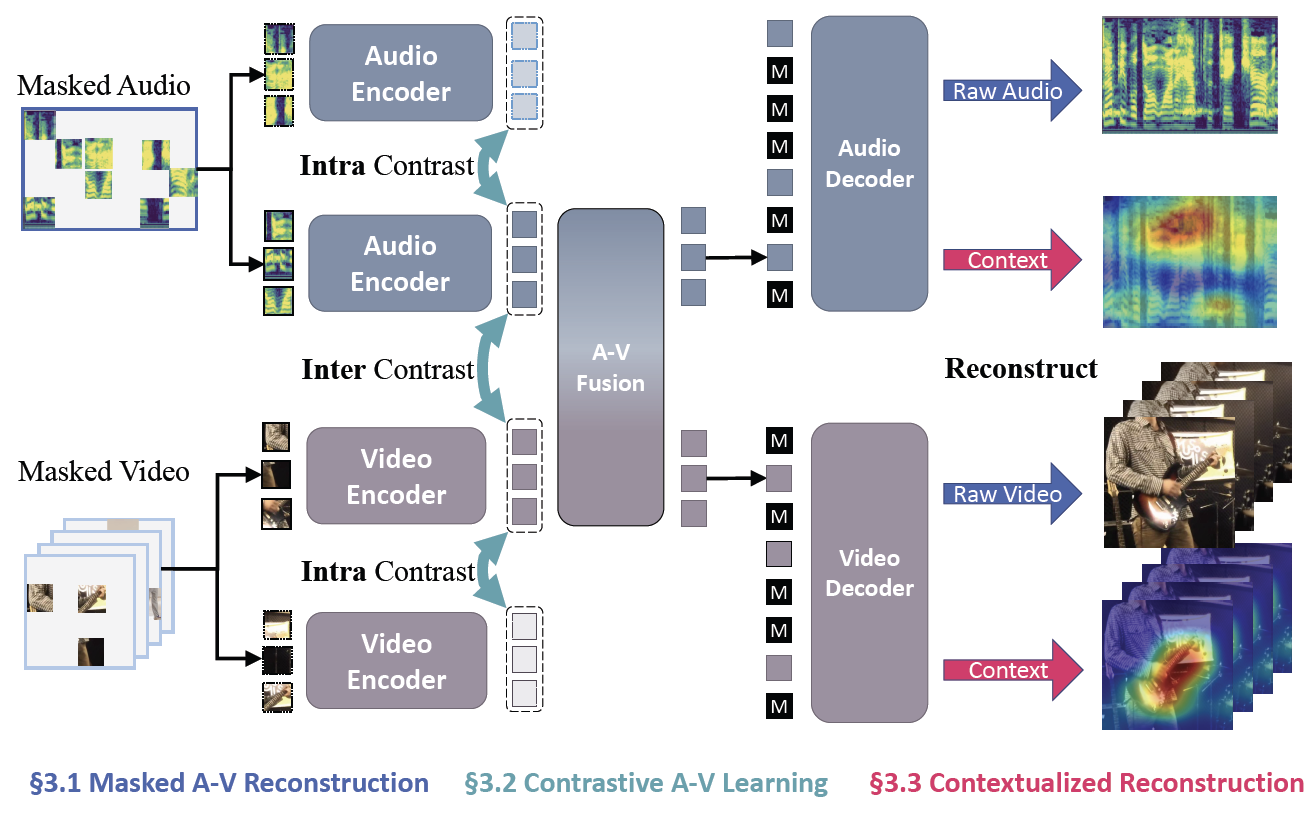
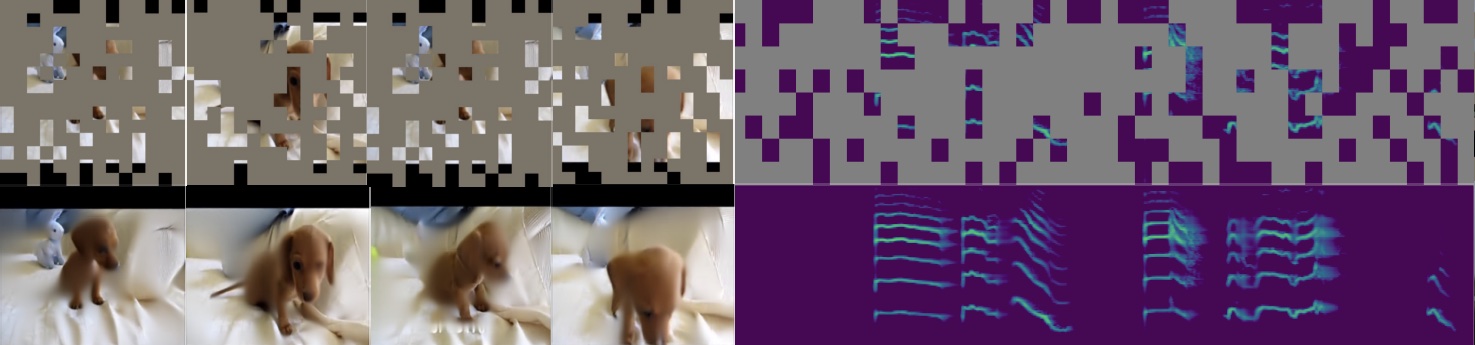
We present Masked Audio-Video Learners (MAViL) to train audio-visual representations. Our approach learns with three complementary forms of self-supervision: (1) reconstruction of masked audio and video input data, (2) intra- and inter-modal contrastive learning with masking, and (3) self-training by reconstructing joint audio-video contextualized features learned from the first two objectives. Pre-training with MAViL not only enables the model to perform well in audio-visual classification and retrieval tasks but also improves representations of each modality in isolation, without using information from the other modality for fine-tuning or inference. Empirically, MAViL sets a new state-of-the-art on AudioSet (53.1 mAP) and VGGSound (67.1% accuracy). For the first time, a self-supervised audio-visual model outperforms ones that use external supervision on these benchmarks.


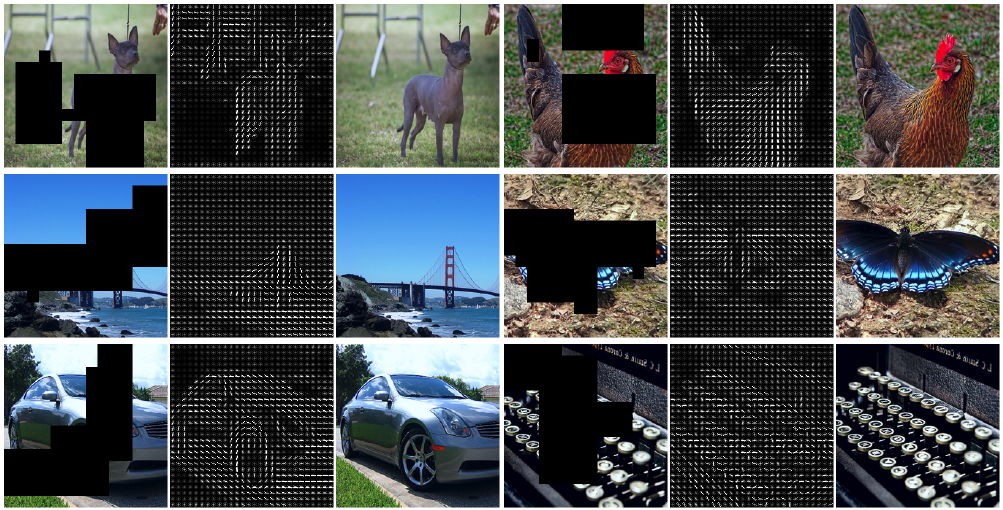
ground-truth DiffMAE MAE
Diffusion Models as Masked Autoencoders
Chen Wei, Karttikeya Mangalam, Po-Yao Huang, Yanghao Li, Haoqi Fan, Hu Xu, Huiyu Wang, Cihang Xie, Alan Yuille, Christoph Feichtenhofer
International Conference on Computer Vision (ICCV) 2023
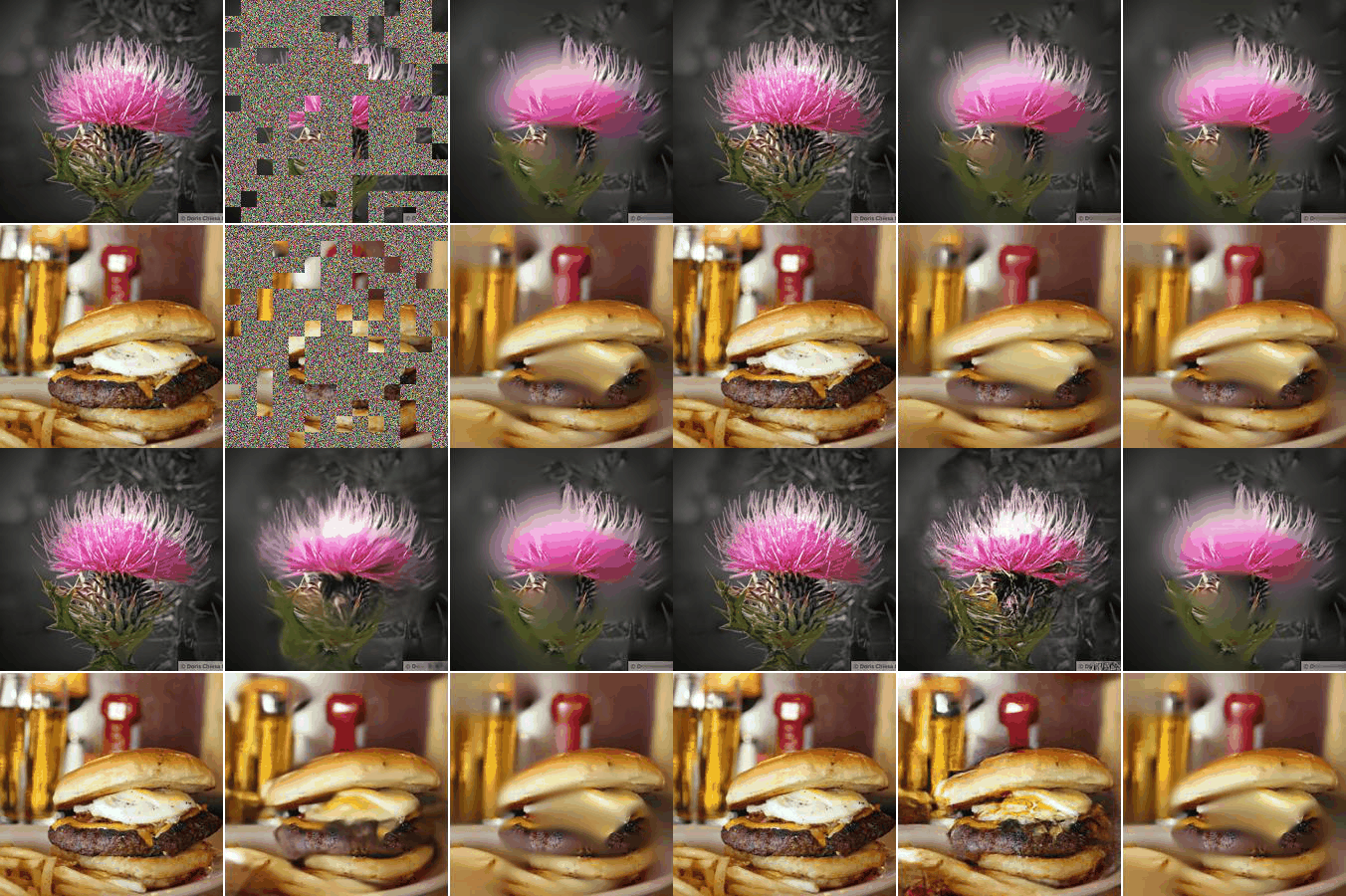
There has been a longstanding belief that generation can facilitate a true understanding of visual data. In line with this, we revisit generatively pre-training visual representations in light of recent interest in denoising diffusion models. While directly pre-training with diffusion models does not produce strong representations, we condition diffusion models on masked input and formulate diffusion models as masked autoencoders (DiffMAE). Our approach is capable of (i) serving as a strong initialization for downstream recognition tasks, (ii) conducting high-quality image inpainting, and (iii) being effortlessly extended to video where it produces state-of-the-art classification accuracy. We further perform a comprehensive study on the pros and cons of design choices and build connections between diffusion models and masked autoencoders.


CiT: Curation in Training for Effective Vision-Language Data
Hu Xu, Saining Xie, Po-Yao Huang, Licheng Yu, Russell Howes, Gargi Ghosh, Luke Zettlemoyer, Christoph Feichtenhofer
International Conference on Computer Vision (ICCV) 2023
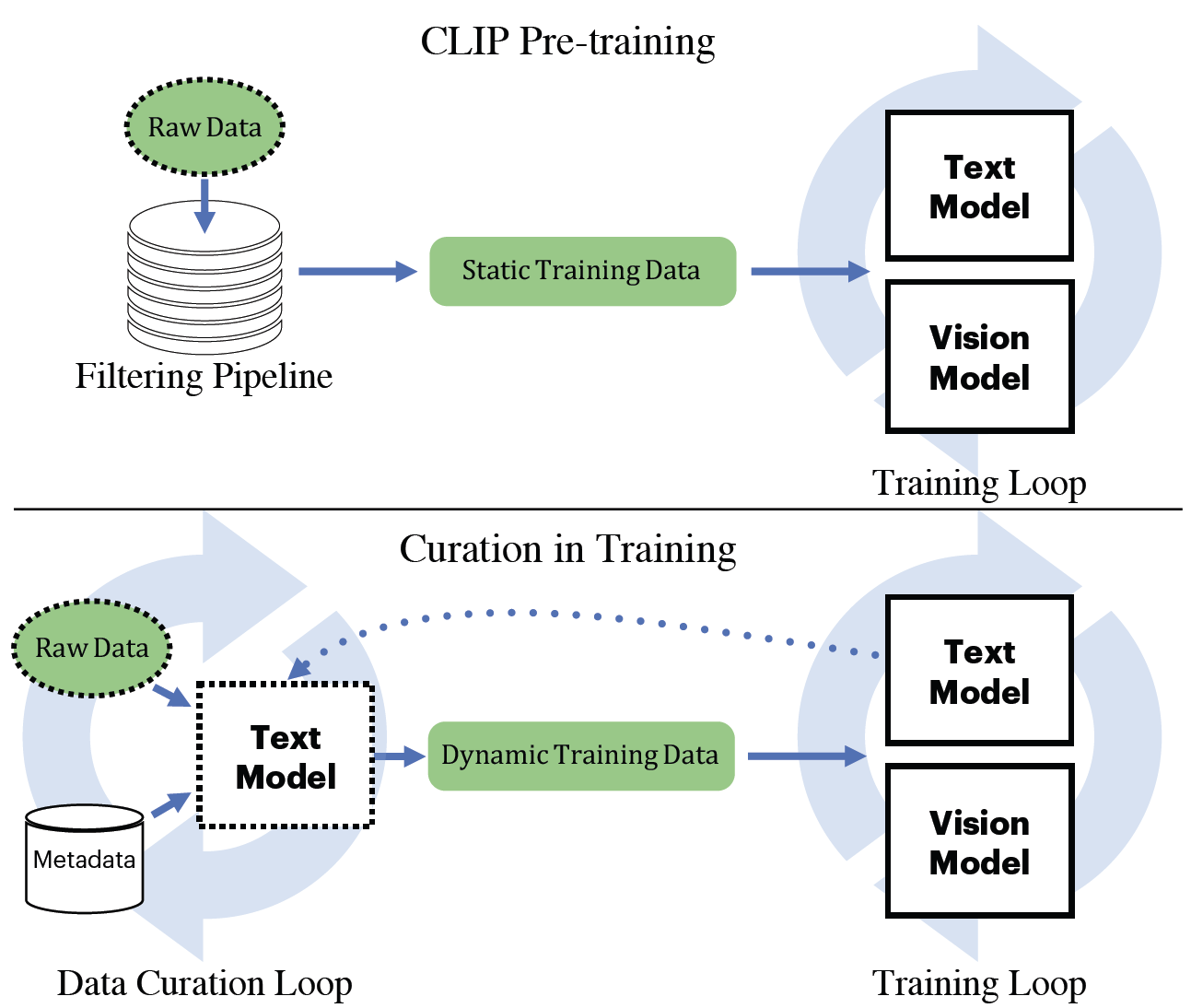
Large vision-language models are generally applicable to many downstream tasks, but come at an exorbitant training cost that only large institutions can afford. This paper trades generality for efficiency and presents Curation in Training (CiT), a simple and efficient vision-text learning algorithm that couples a data objective into training. CiT automatically yields quality data to speed-up contrastive image-text training and alleviates the need for an offline data filtering pipeline, allowing broad data sources (including raw image-text pairs from the web). CiT contains two loops: an outer loop curating the training data and an inner loop consuming the curated training data. The text encoder connects the two loops. Given metadata for tasks of interest, e.g., class names, and a large pool of image-text pairs, CiT alternatively selects relevant training data from the pool by measuring the similarity of their text embeddings and embeddings of the metadata. In our experiments, we observe that CiT can speed up training by over an order of magnitude, especially if the raw data size is large.


The effectiveness of MAE pre-pretraining for billion-scale pretraining
Mannat Singh*, Quentin Duval*, Kalyan Vasudev Alwala*, Haoqi Fan, Vaibhav Aggarwal, Aaron Adcock, Armand Joulin, Piotr Dollár, Christoph Feichtenhofer, Ross Girshick, Rohit Girdhar, Ishan Misra
International Conference on Computer Vision (ICCV) 2023
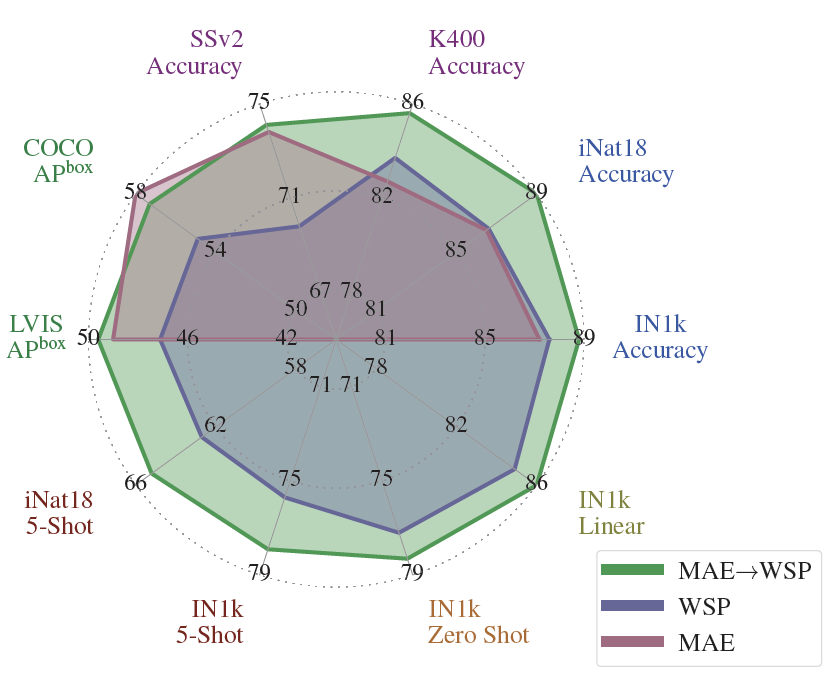
This paper revisits the standard pretrain-then-finetune paradigm used in computer vision for visual recognition tasks. Typically, state-of-the-art foundation models are pretrained using large scale (weakly) supervised datasets with billions of images. We introduce an additional pre-pretraining stage that is simple and uses the self-supervised MAE technique to initialize the model. While MAE has only been shown to scale with the size of models, we find that it scales with the size of the training dataset as well. Thus, our MAE-based pre-pretraining scales with both model and data size making it applicable for training foundation models. Pre-pretraining consistently improves both the model convergence and the downstream transfer performance across a range of model scales (millions to billions of parameters), and dataset sizes (millions to billions of images).


Scaling Language-Image Pre-training via Masking
Yanghao Li*, Haoqi Fan*, Ronghang Hu*, Christoph Feichtenhofer, Kaiming He
*equal technical contribution, equal advising
Conference on Computer Vision and Pattern Recognition (CVPR) 2023
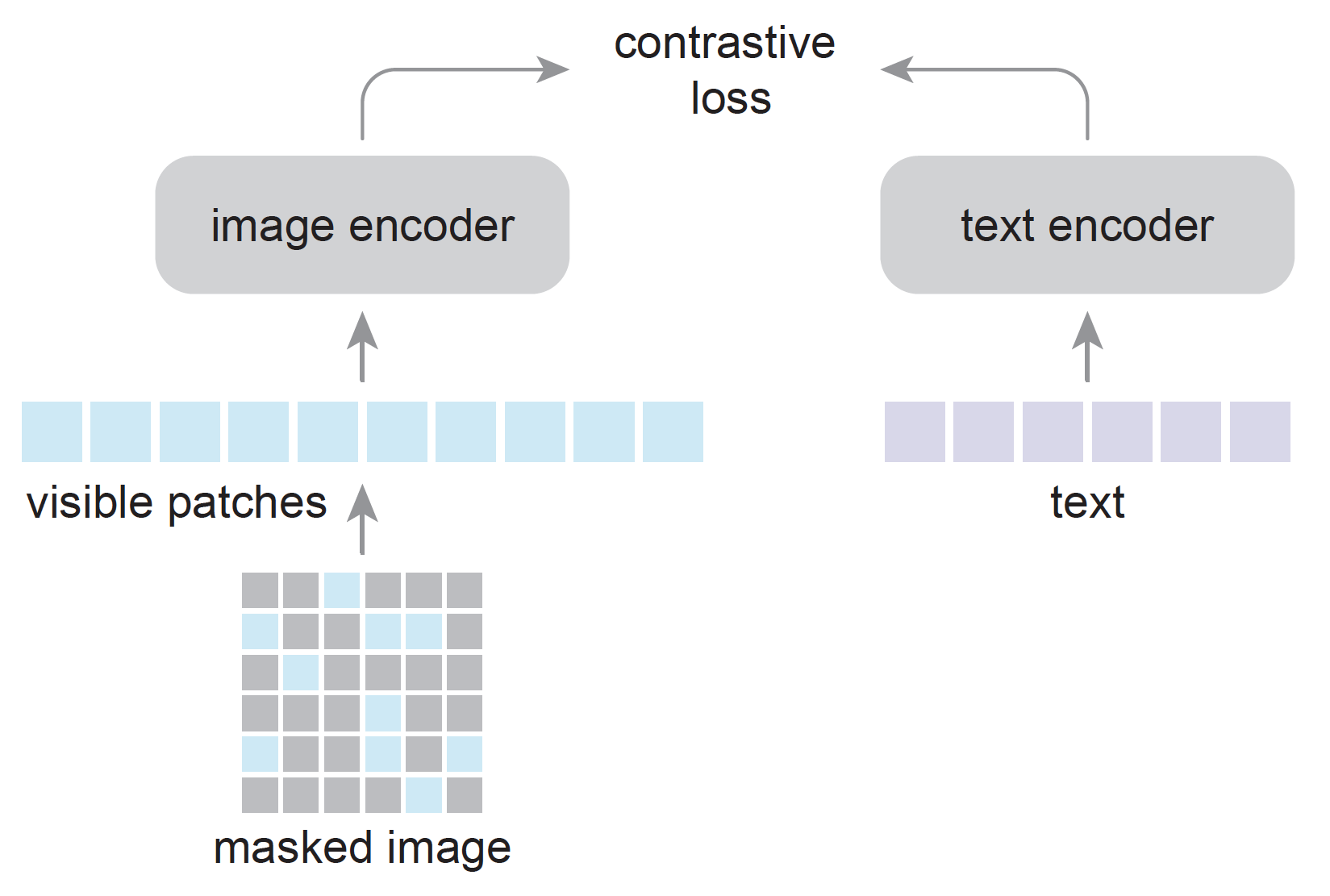
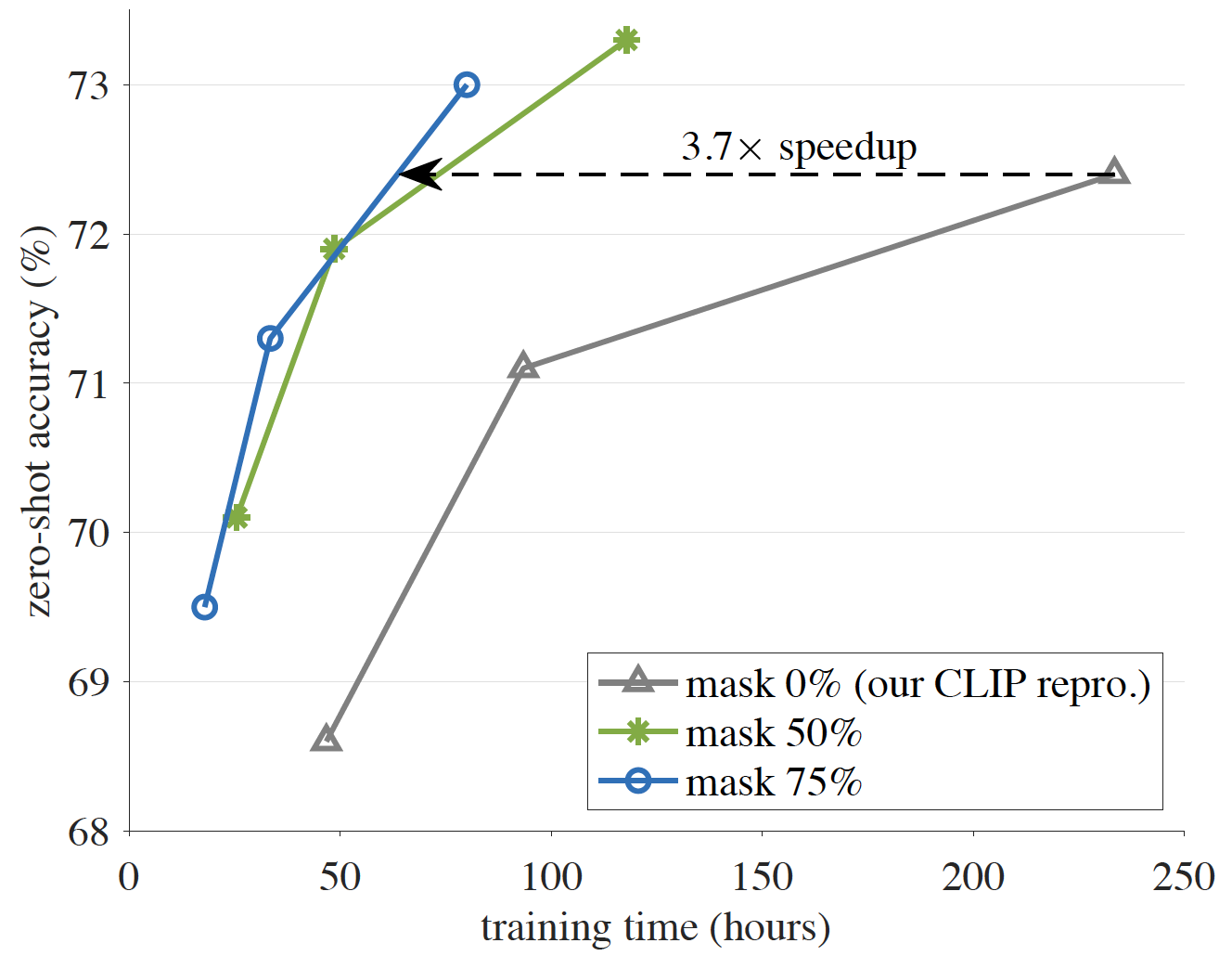
We present Fast Language-Image Pre-training (FLIP), a simple and more efficient method for training CLIP. Our method randomly masks out and removes a large portion of image patches during training. Masking allows us to learn from more image-text pairs given the same wall-clock time and contrast more samples per iteration with similar memory footprint. It leads to a favorable trade-off between accuracy and training time. In our experiments on 400 million image-text pairs, FLIP improves both accuracy and speed over the no-masking baseline. On a large diversity of downstream tasks, FLIP dominantly outperforms the CLIP counterparts trained on the same data. Facilitated by the speedup, we explore the scaling behavior of increasing the model size, data size, or training length, and report encouraging results and comparisons. We hope that our work will foster future research on scaling vision-language learning.


Multiview Compressive Coding for 3D Reconstruction
Chao-Yuan Wu, Justin Johnson, Jitendra Malik, Christoph Feichtenhofer, Georgia Gkioxari
Conference on Computer Vision and Pattern Recognition (CVPR) 2023
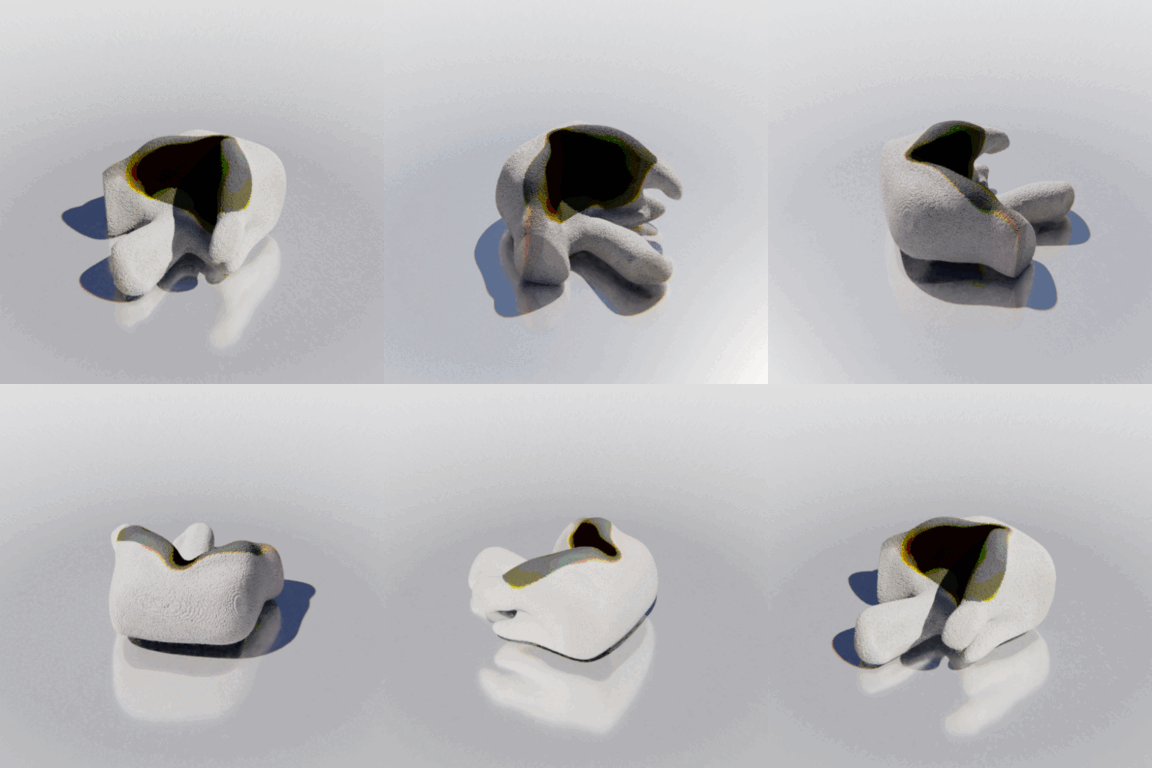
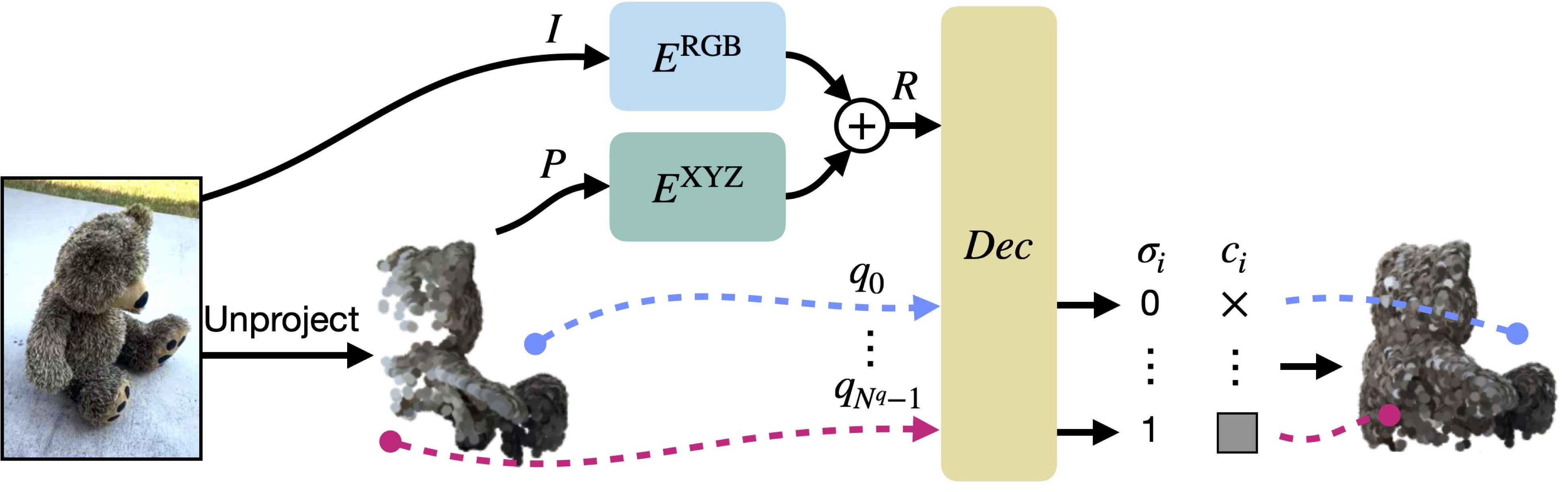
A central goal of visual recognition is to understand objects and scenes from a single image. 2D recognition has witnessed tremendous progress thanks to large-scale learning and general-purpose representations. Comparatively, 3D poses new challenges stemming from occlusions not depicted in the image. Prior works try to overcome these by inferring from multiple views or rely on scarce CAD models and category-specific priors which hinder scaling to novel settings. In this work, we explore single-view 3D reconstruction by learning generalizable representations inspired by advances in self-supervised learning. We introduce a simple framework that operates on 3D points of single objects or whole scenes coupled with category-agnostic large-scale training from diverse RGB-D videos. Our model, Multiview Compressive Coding (MCC), learns to compress the input appearance and geometry to predict the 3D structure by querying a 3D-aware decoder. MCC's generality and efficiency allow it to learn from large-scale and diverse data sources with strong generalization to novel objects imagined by DALL-E 2 or captured in-the-wild with an iPhone.


Token Merging: Your ViT But Faster
Daniel Bolya, Cheng-Yang Fu, Xiaoliang Dai, Peizhao Zhang, Christoph Feichtenhofer, Judy Hoffman
International Conference on Learning Representations (ICLR) 2023, Oral
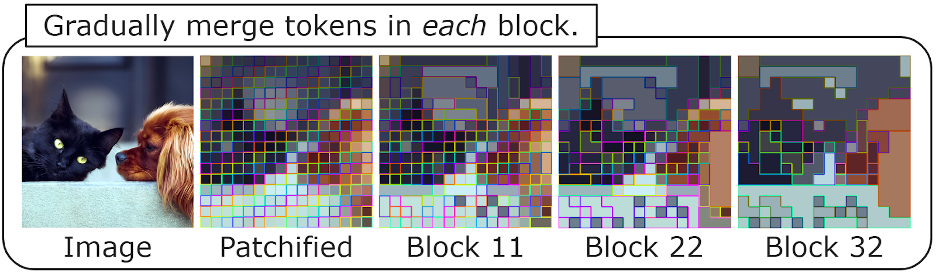
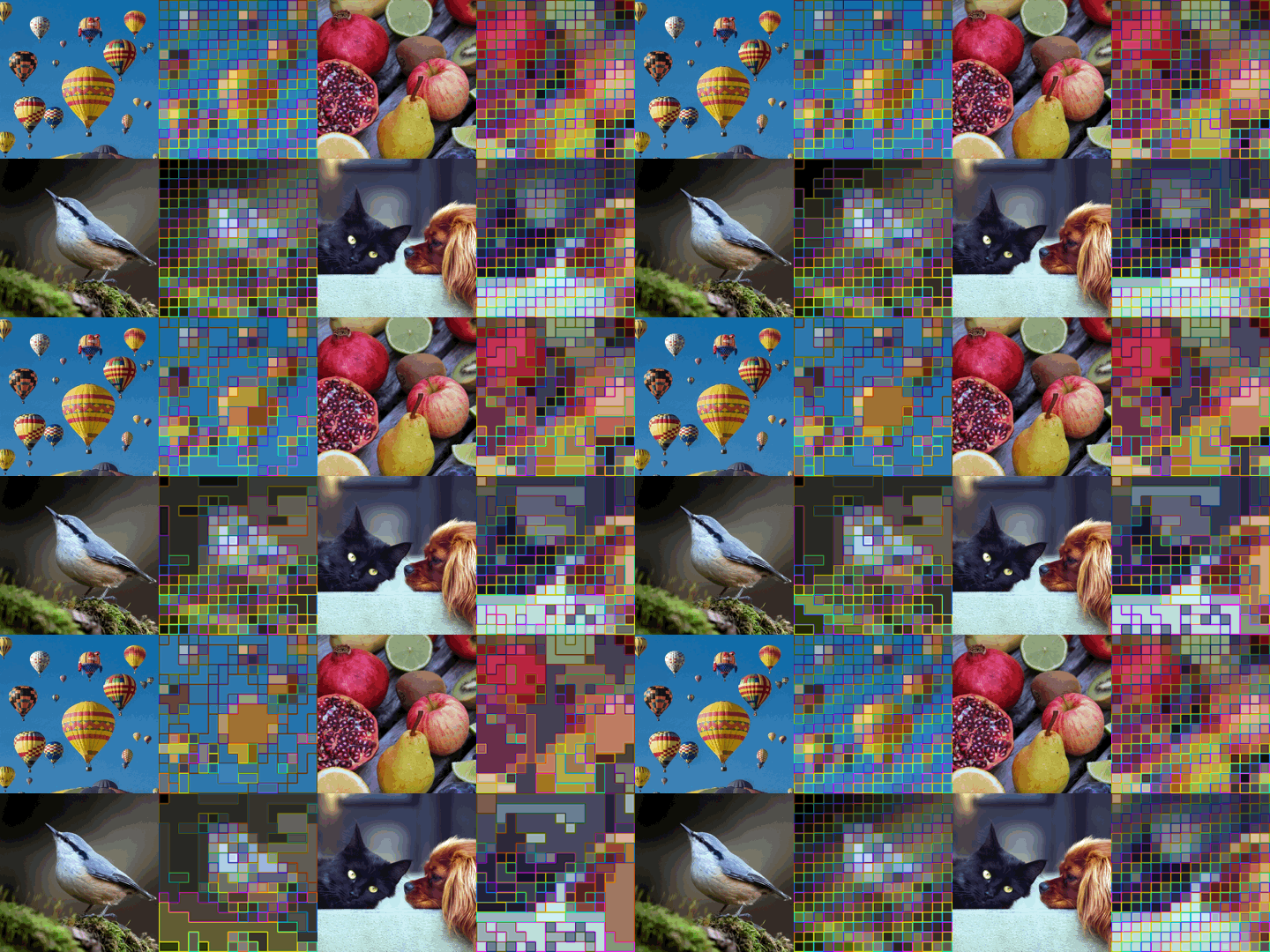
We introduce Token Merging (ToMe), a simple method to increase the throughput of existing ViT models without needing to train. ToMe gradually combines similar tokens in a transformer using a general and light-weight matching algorithm that is as fast as pruning while being more accurate. Off-the-shelf, ToMe can 2x the throughput of state-of-the-art ViT-L @ 512 and ViT-H @ 518 models on images and 2.2x the throughput of ViT-L on video with only a 0.2-0.3% accuracy drop in each case. ToMe can also easily be applied during training, improving in practice training speed up to 2x for MAE fine-tuning on video. Training with ToMe further minimizes accuracy drop, leading to 2x the throughput of ViT-B on audio for only a 0.4% mAP drop. Qualitatively, we find that ToMe merges object parts into one token, even over multiple frames of video. Overall, ToMe's accuracy and speed are competitive with state-of-the-art on images, video, and audio.


Masked Autoencoders As Spatiotemporal Learners
Christoph Feichtenhofer*, Haoqi Fan*, Yanghao Li, Kaiming He
*equal technical contribution
Advances in Neural Information Processing Systems (NeurIPS) 2022
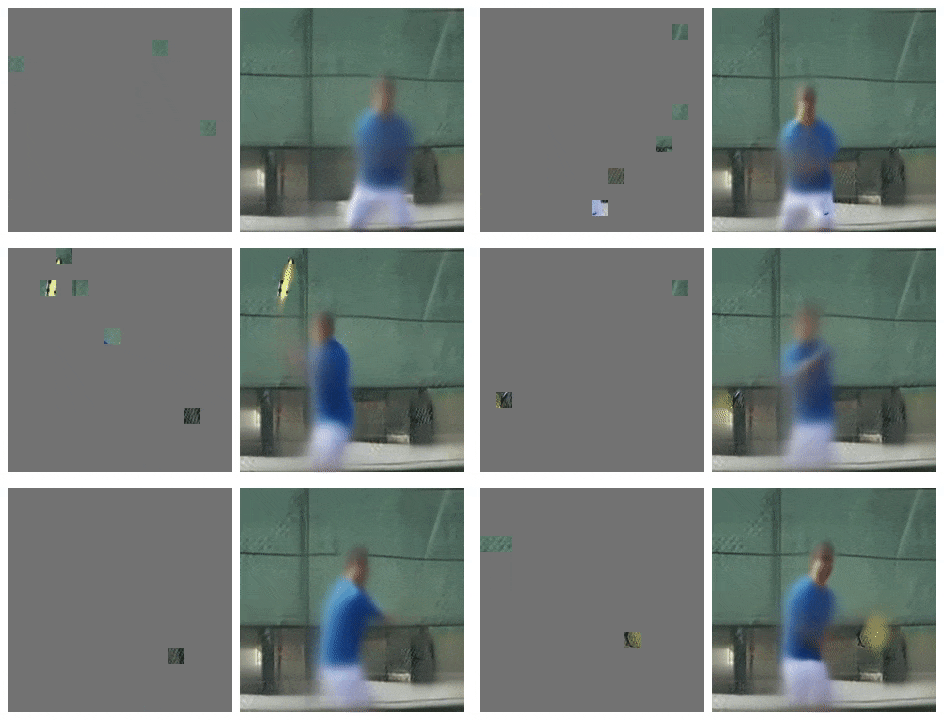
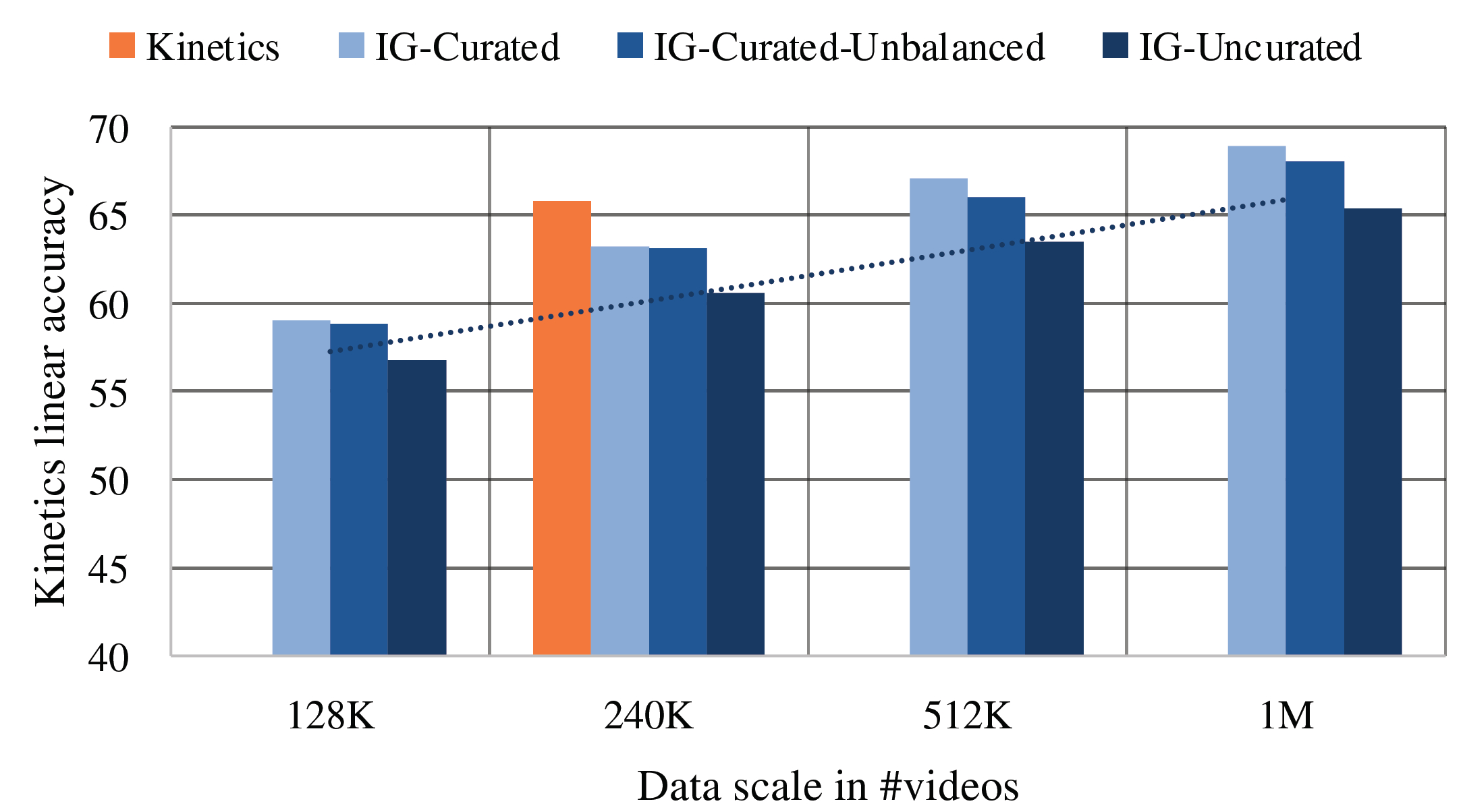
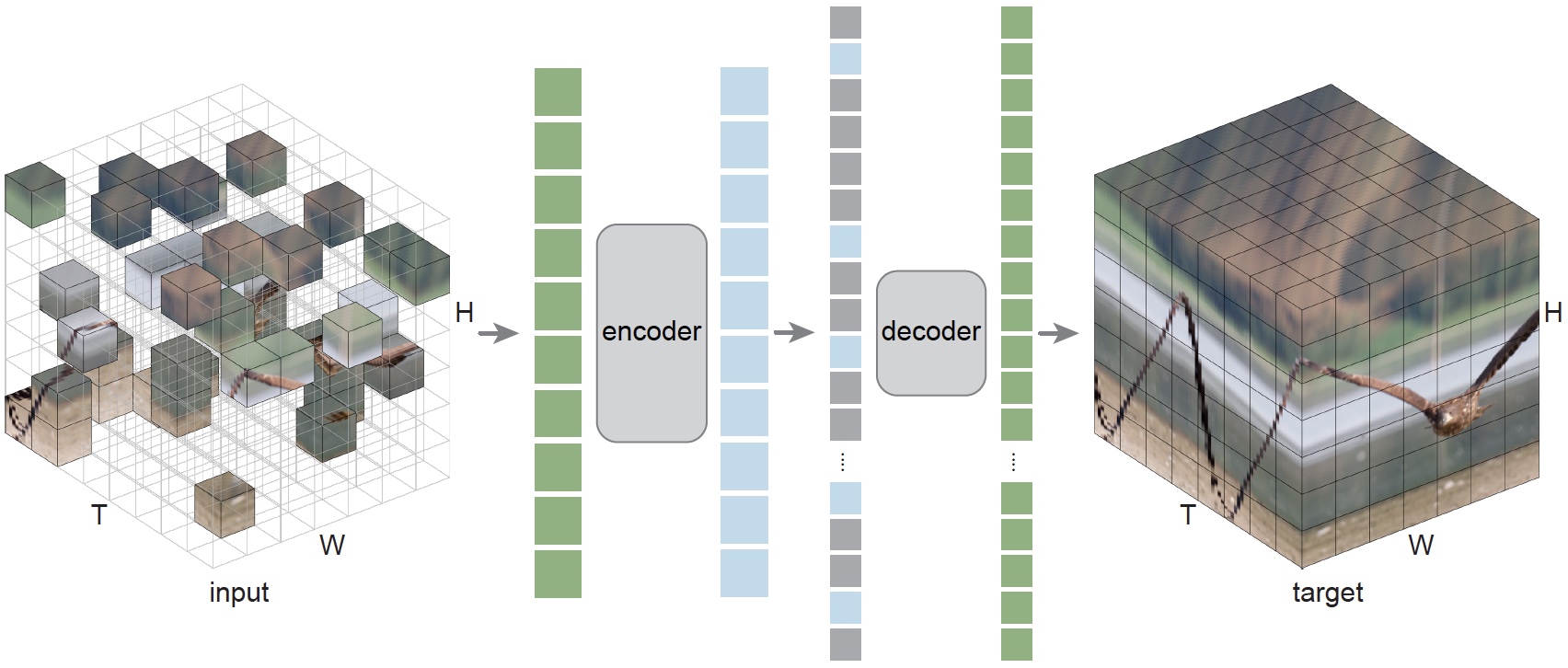
This paper studies a conceptually simple extension of Masked Autoencoders (MAE) to spatiotemporal representation learning from videos. We randomly mask out spacetime patches in videos and learn an autoencoder to reconstruct them in pixels. Interestingly, we show that our MAE method can learn strong representations with almost no inductive bias on spacetime (only except for patch and positional embeddings), and spacetime-agnostic random masking performs the best. We observe that the optimal masking ratio is as high as 90% (vs. 75% on images), supporting the hypothesis that this ratio is related to information redundancy of the data. A high masking ratio leads to a large speedup, e.g., > 4x in wall-clock time or even more. We report competitive results on several challenging video datasets using vanilla Vision Transformers. We observe that MAE can outperform supervised pre-training by large margins. We further report encouraging results of training on real-world, uncurated Instagram data. Our study suggests that the general framework of masked autoencoding (BERT, MAE, etc.) can be a unified methodology for representation learning with minimal domain knowledge.


Masked Autoencoders that Listen
Po-Yao Huang, Hu Xu, Juncheng Li, Alexei Baevski, Michael Auli, Wojciech Galuba, Florian Metze, Christoph Feichtenhofer
Advances in Neural Information Processing Systems (NeurIPS) 2022
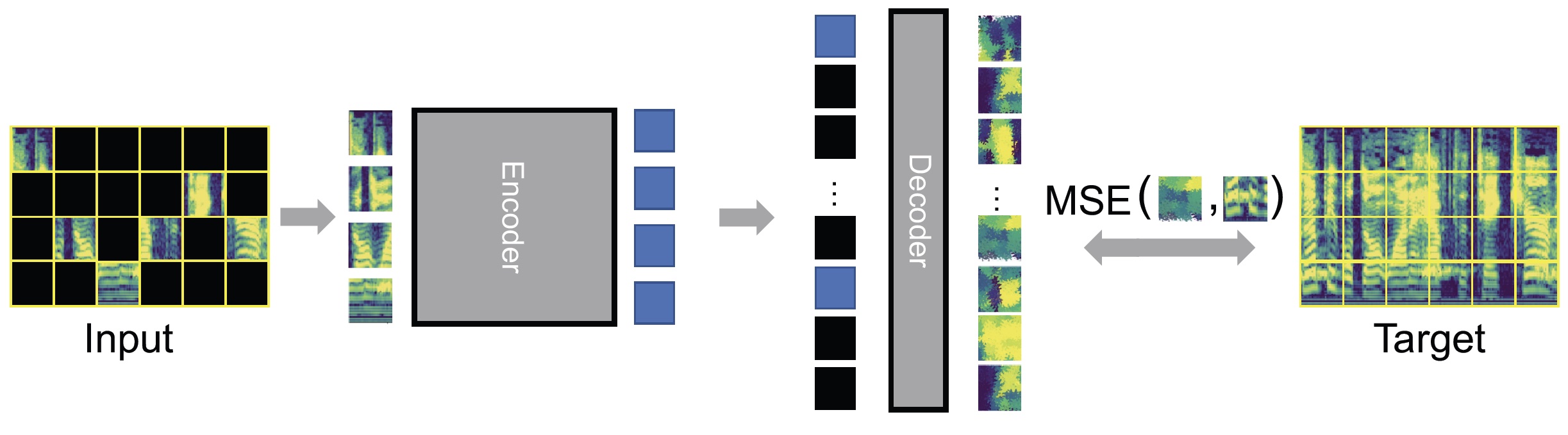
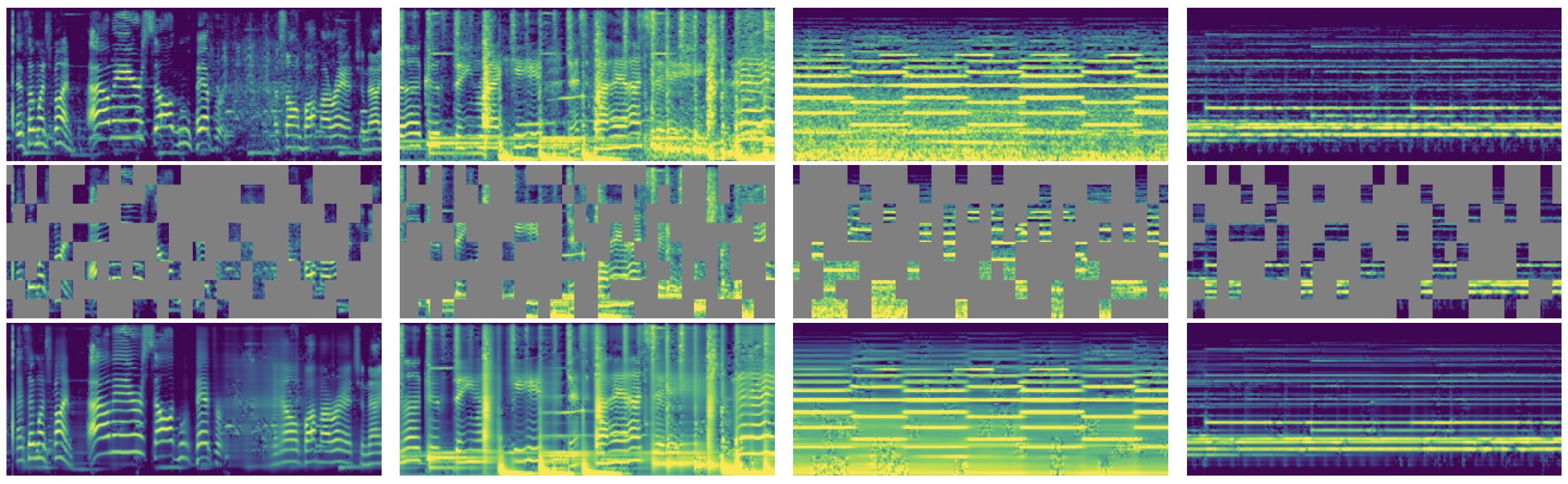
This paper studies a simple extension of image-based Masked Autoencoders (MAE) to self-supervised representation learning from audio spectrograms. Following the Transformer encoder-decoder design in MAE, our Audio-MAE first encodes audio spectrogram patches with a high masking ratio, feeding only the non-masked tokens through encoder layers. The decoder then re-orders and decodes the encoded context padded with mask tokens, in order to reconstruct the input spectrogram. We find it beneficial to incorporate local window attention in the decoder, as audio spectrograms are highly correlated in local time and frequency bands. We then fine-tune the encoder with a lower masking ratio on target datasets. Empirically, Audio-MAE sets new state-of-the-art performance on six audio and speech classification tasks, outperforming other recent models that use external supervised pre-training.


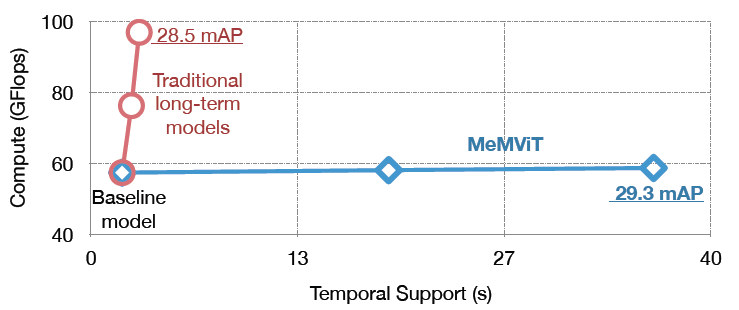
MeMViT: Memory-Augmented Multiscale Vision Transformer for Efficient Long-Term Video Recognition
Chao-Yuan Wu*, Yanghao Li*, Karttikeya Mangalam, Haoqi Fan, Bo Xiong, Jitendra Malik, Christoph Feichtenhofer*
*equal technical contribution
Conference on Computer Vision and Pattern Recognition (CVPR) 2022 (Oral)
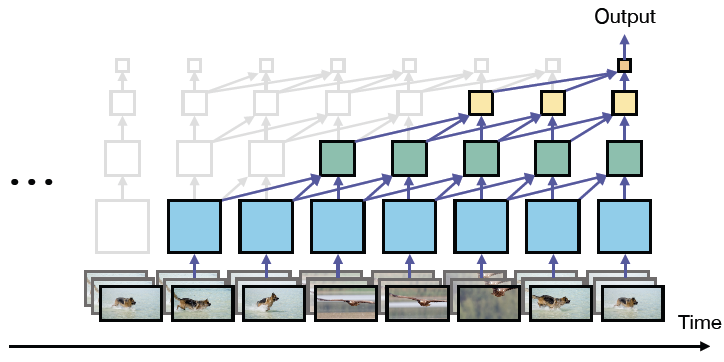
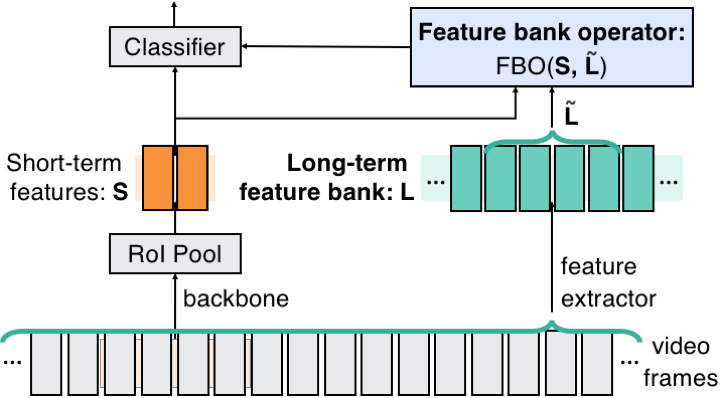
In this paper, we propose a new strategy to overcome this challenge. Instead of trying to process more frames at once like most existing methods, we propose to process videos in an online fashion and cache "memory" at each iteration. Through the memory, the model can reference prior context for long-term modeling, with only a marginal cost. Based on this idea, we build MeMViT, a Memory-augmented Multiscale Vision Transformer, that has a temporal support 30x longer than existing models with only 4.5% more compute; traditional methods need >3,000% more compute to do the same. On a wide range of settings, the increased temporal support enabled by MeMViT brings large gains in recognition accuracy consistently. MeMViT obtains state-of-the-art results on the AVA, EPIC-Kitchens-100 action classification, and action anticipation datasets. Code and models will be made publicly available.


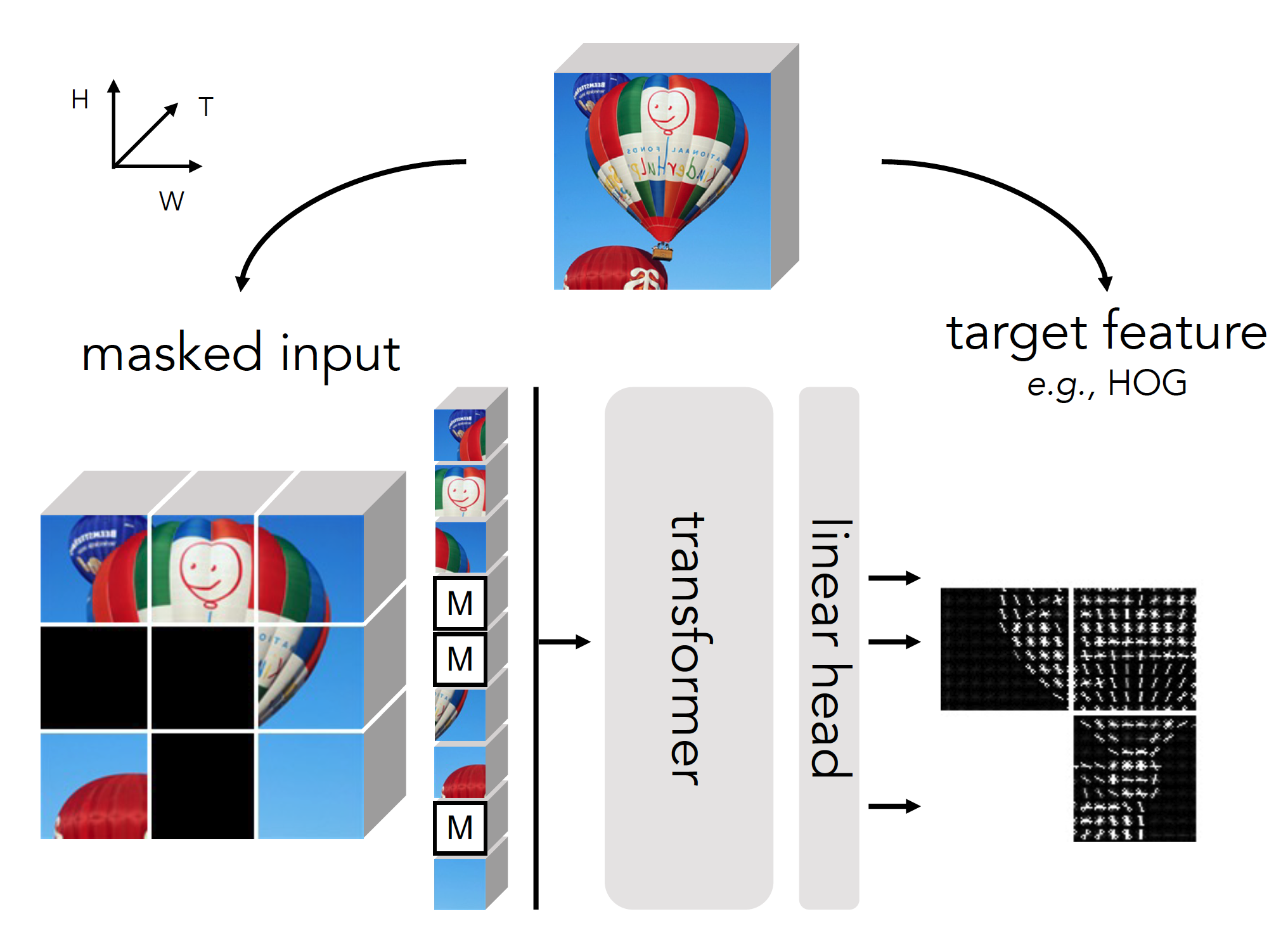
Masked Feature Prediction for Self-Supervised Visual Pre-Training
Chen Wei*, Haoqi Fan, Saining Xie, Chao-Yuan Wu, Alan Yuille, Christoph Feichtenhofer*
*equal technical contribution
Conference on Computer Vision and Pattern Recognition (CVPR) 2022
We present Masked Feature Prediction (MaskFeat) for self-supervised pre-training of video models. Our approach first randomly masks out a portion of the input sequence and then predicts the feature of the masked regions. We study five different types of features and find Histograms of Oriented Gradients (HOG), a hand-crafted feature descriptor, works particularly well in terms of both performance and efficiency. We observe that the local contrast normalization in HOG is essential for good results, which is in line with earlier work using HOG for visual recognition. Our approach can learn abundant visual knowledge and drive large-scale Transformer-based models. Without using extra model weights or supervision, MaskFeat pre-trained on unlabeled videos achieves unprecedented results of 86.7% with MViT-L on Kinetics-400, 88.3% on Kinetics-600, 80.4% on Kinetics-700, 38.8 mAP on AVA, and 75.0% on SSv2. MaskFeat further generalizes to image input, which can be interpreted as a video with a single frame and obtains competitive results on ImageNet.


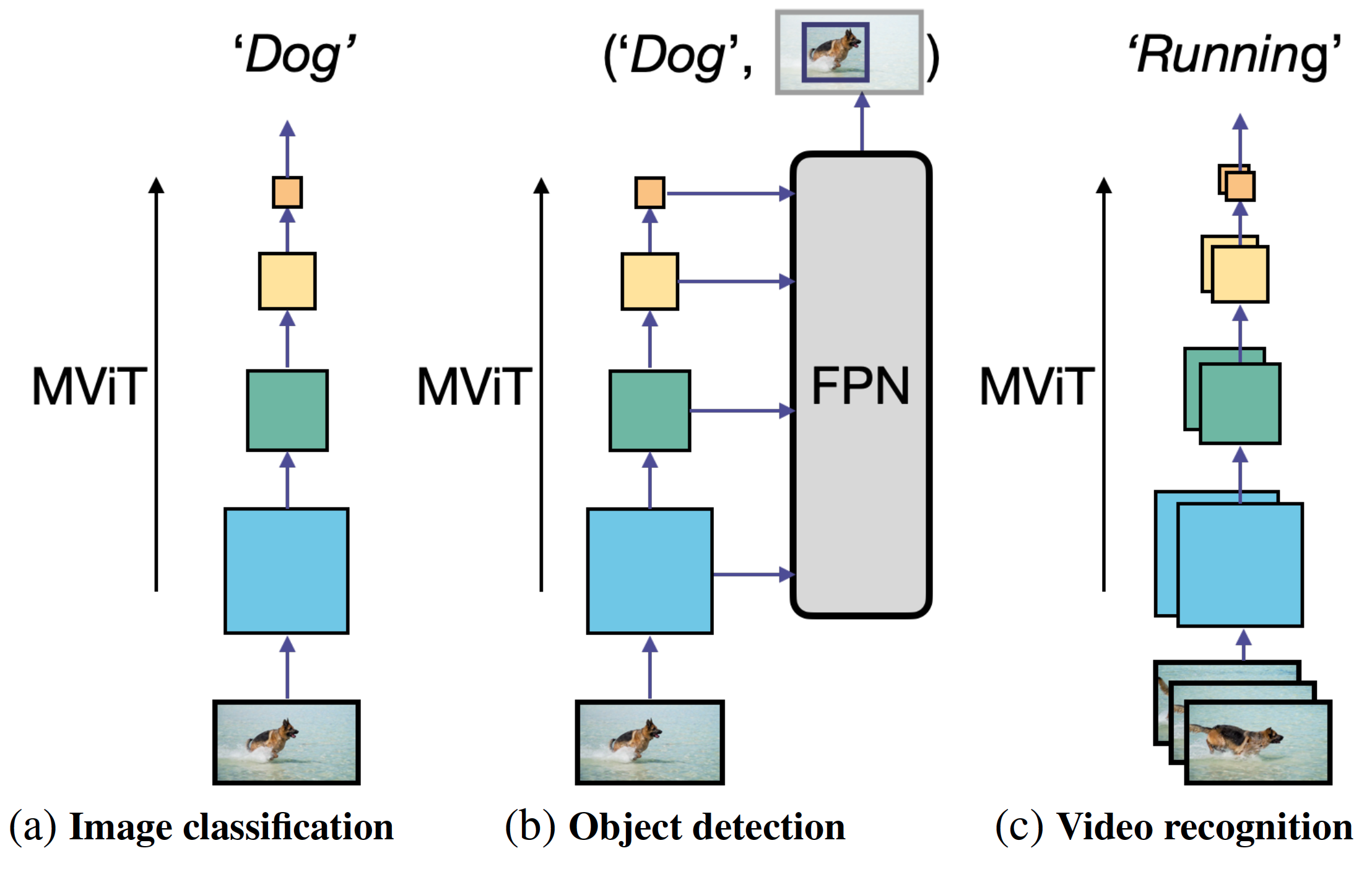
MViTv2: Improved Multiscale Vision Transformers for Classification and Detection
Yanghao Li*, Chao-Yuan Wu*, Haoqi Fan, Karttikeya Mangalam, Bo Xiong, Jitendra Malik, Christoph Feichtenhofer*
*equal technical contribution
Conference on Computer Vision and Pattern Recognition (CVPR) 2022
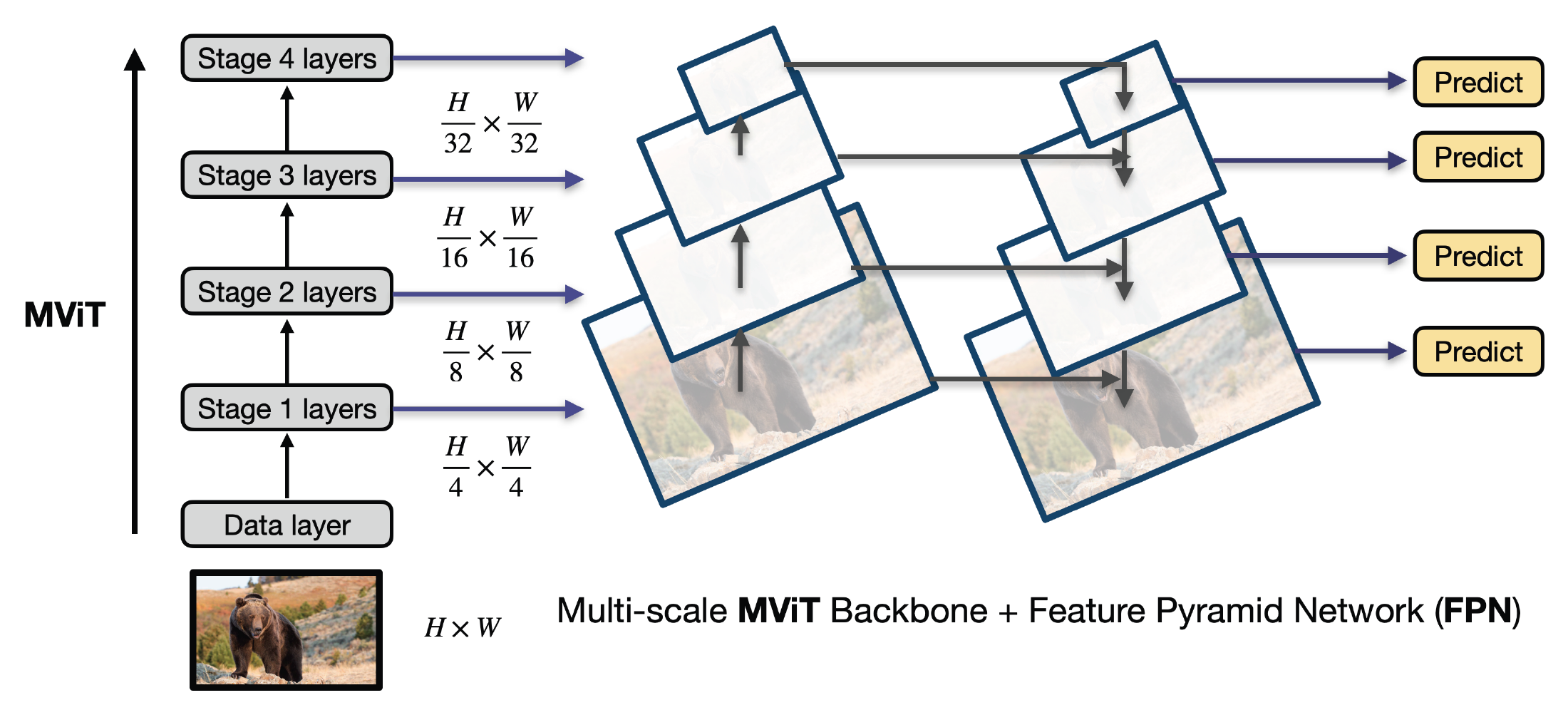
In this paper, we study Multiscale Vision Transformers (MViT) as a unified architecture for image and video classification, as well as object detection. We present an improved version of MViT that incorporates decomposed relative positional embeddings and residual pooling connections. We instantiate this architecture in five sizes and evaluate it for ImageNet classification, COCO detection and Kinetics video recognition where it outperforms prior work. We further compare MViTs' pooling attention to window attention mechanisms where it outperforms the latter in accuracy/compute. Without bells-and-whistles, MViT has state-of-the-art performance in 3 domains: 88.8% accuracy on ImageNet classification, 56.1 box AP on COCO object detection as well as 86.1% on Kinetics-400 video classification.


Reversible Vision Transformers
Karttikeya Mangalam*, Haoqi Fan, Yanghao Li, Chao-Yuan Wu, Bo Xiong, Christoph Feichtenhofer*, Jitendra Malik
*equal technical contribution
Conference on Computer Vision and Pattern Recognition (CVPR) 2022 (Oral)
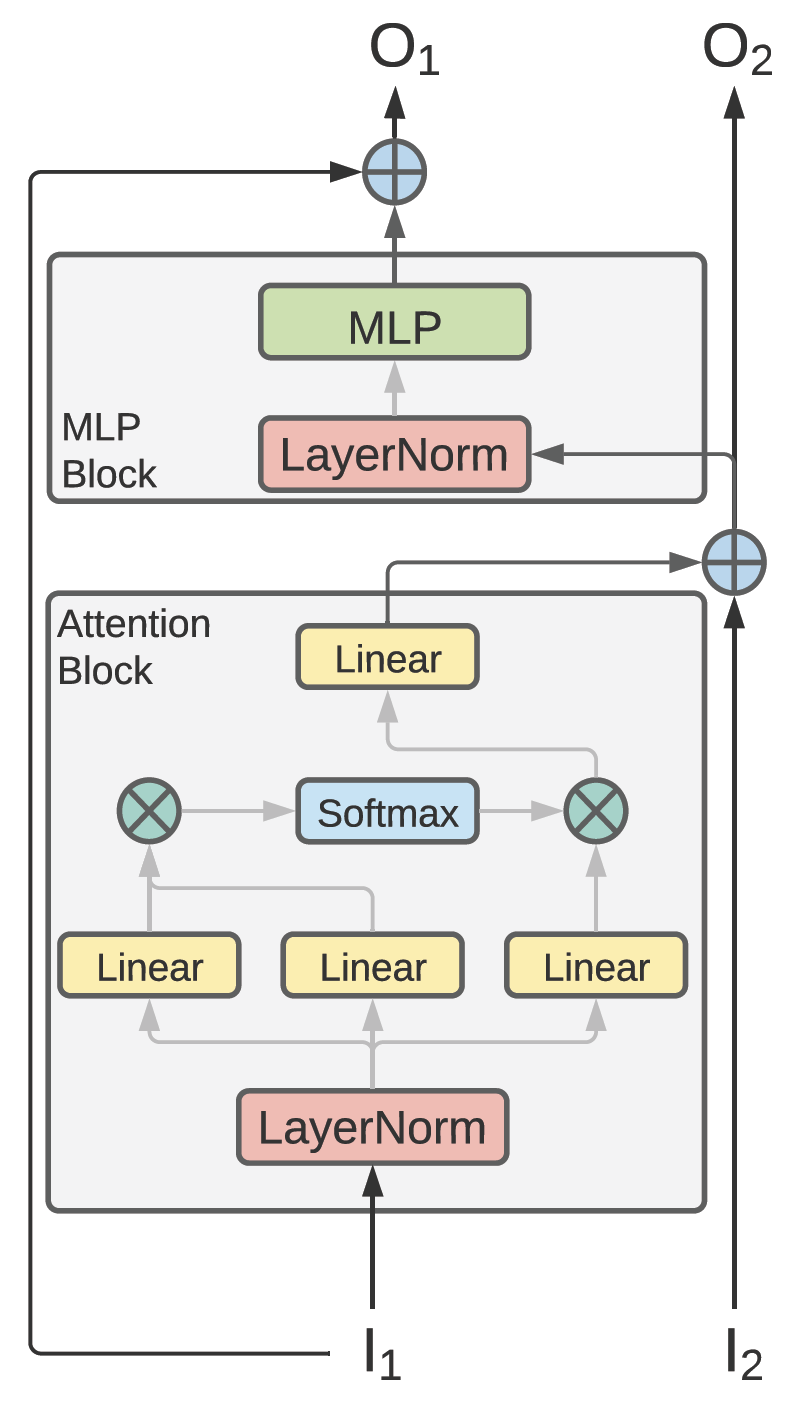
We present Reversible Vision Transformers, a memory efficient architecture design for visual recognition. By decoupling the GPU memory footprint from the depth of the model, Reversible Vision Transformers enable memory efficient scaling of transformer architectures. We adapt two popular models, namely Vision Transformer and Multi-scale Vision Transformers, to reversible variants and benchmark extensively across both model sizes and tasks of image classification, object detection and video classification. Reversible Vision Transformers achieve a reduced memory footprint of up to 15.5x at identical model complexity, parameters and accuracy, demonstrating the promise of reversible vision transformers as an efficient backbone for resource limited training regimes. Finally, we find that the additional computational burden of recomputing activations is more than overcome for deeper models, where throughput can increase up to 3.9x over their non-reversible counterparts.


A convnet for the 2020s
Zhuang Liu, Hanzi Mao, Chao-Yuan Wu, Christoph Feichtenhofer, Trevor Darrell, Saining Xie
Conference on Computer Vision and Pattern Recognition (CVPR) 2022
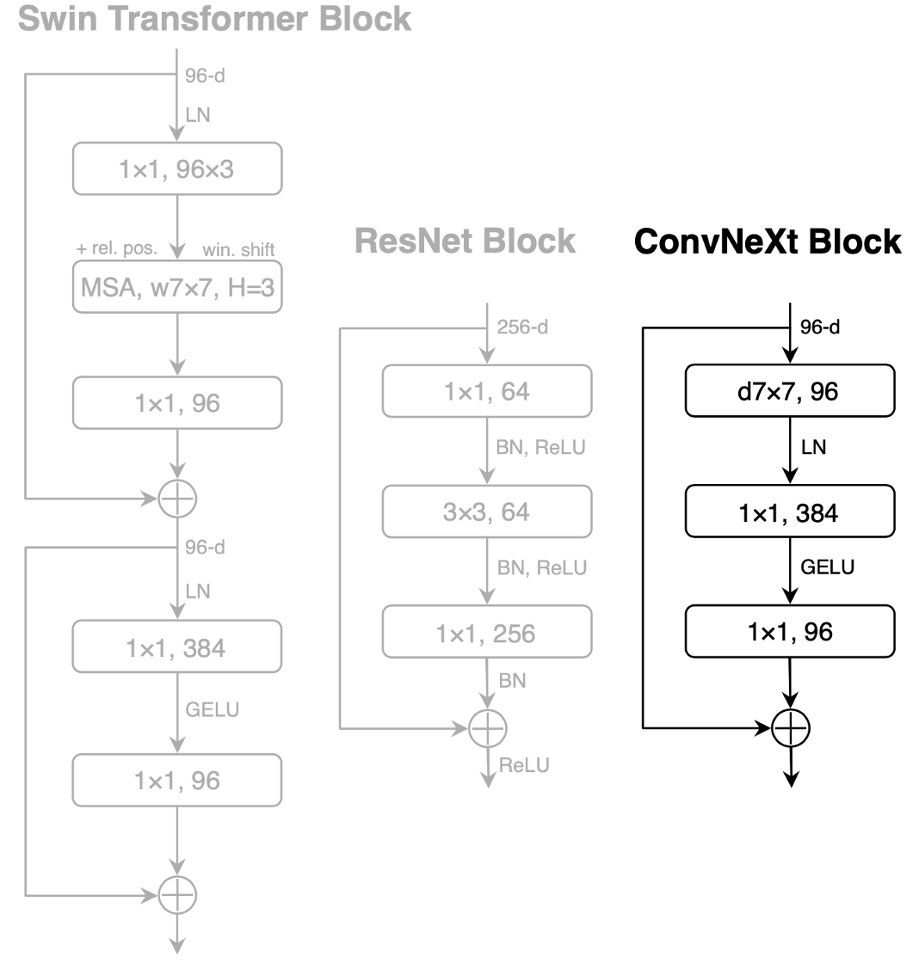
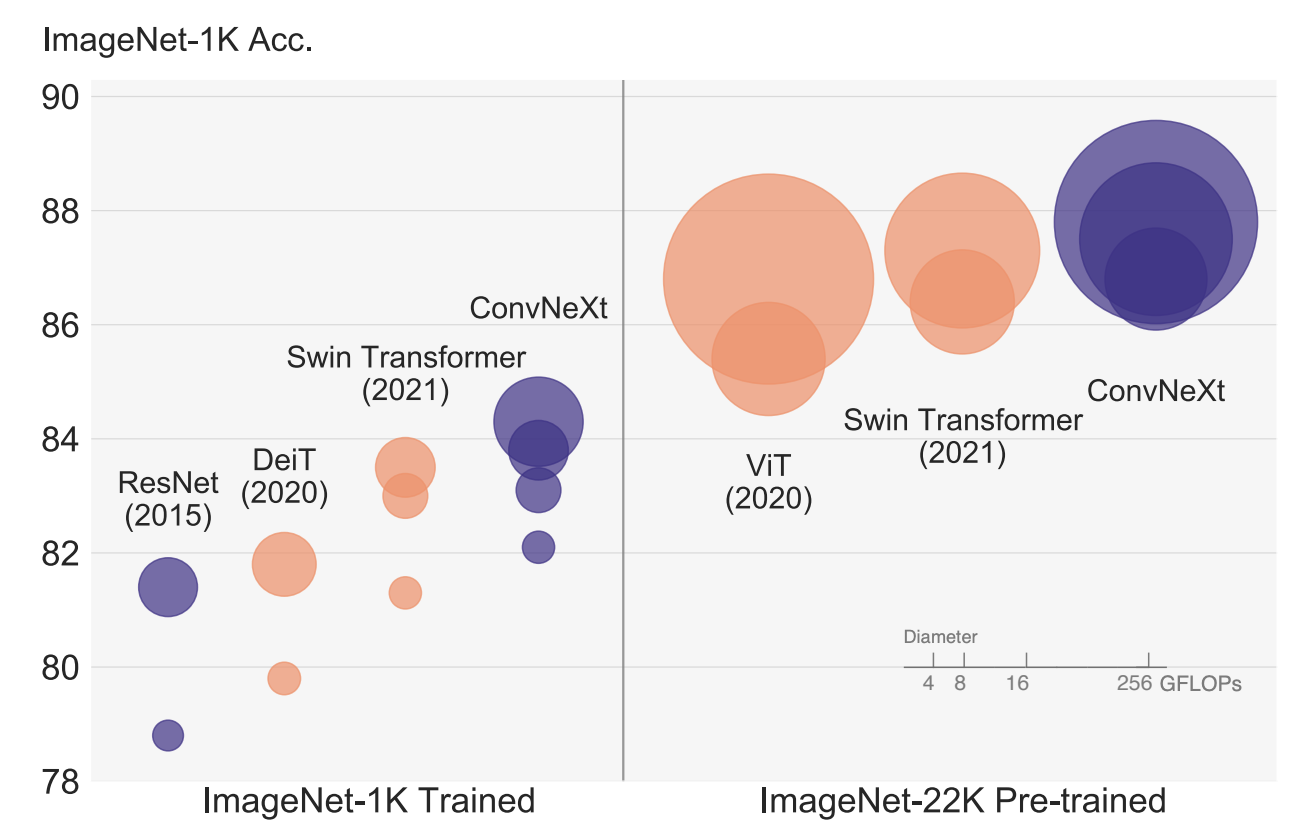
The "Roaring 20s" of visual recognition began with the introduction of Vision Transformers (ViTs), which quickly superseded ConvNets as the state-of-the-art image classification model. A vanilla ViT, on the other hand, faces difficulties when applied to general computer vision tasks such as object detection and semantic segmentation. It is the hierarchical Transformers (e.g., Swin Transformers) that reintroduced several ConvNet priors, making Transformers practically viable as a generic vision backbone and demonstrating remarkable performance on a wide variety of vision tasks. However, the effectiveness of such hybrid approaches is still largely credited to the intrinsic superiority of Transformers, rather than the inherent inductive biases of convolutions. In this work, we reexamine the design spaces and test the limits of what a pure ConvNet can achieve. We gradually "modernize" a standard ResNet toward the design of a vision Transformer, and discover several key components that contribute to the performance difference along the way. The outcome of this exploration is a family of pure ConvNet models dubbed ConvNeXt. Constructed entirely from standard ConvNet modules, ConvNeXts compete favorably with Transformers in terms of accuracy and scalability, achieving 87.8% ImageNet top-1 accuracy and outperforming Swin Transformers on COCO detection and ADE20K segmentation, while maintaining the simplicity and efficiency of standard ConvNets.

TrackFormer: Multi-Object Tracking with Transformers
Tim Meinhardt, Alexander Kirillov, Laura Leal-Taixé, Christoph Feichtenhofer
Conference on Computer Vision and Pattern Recognition (CVPR) 2022
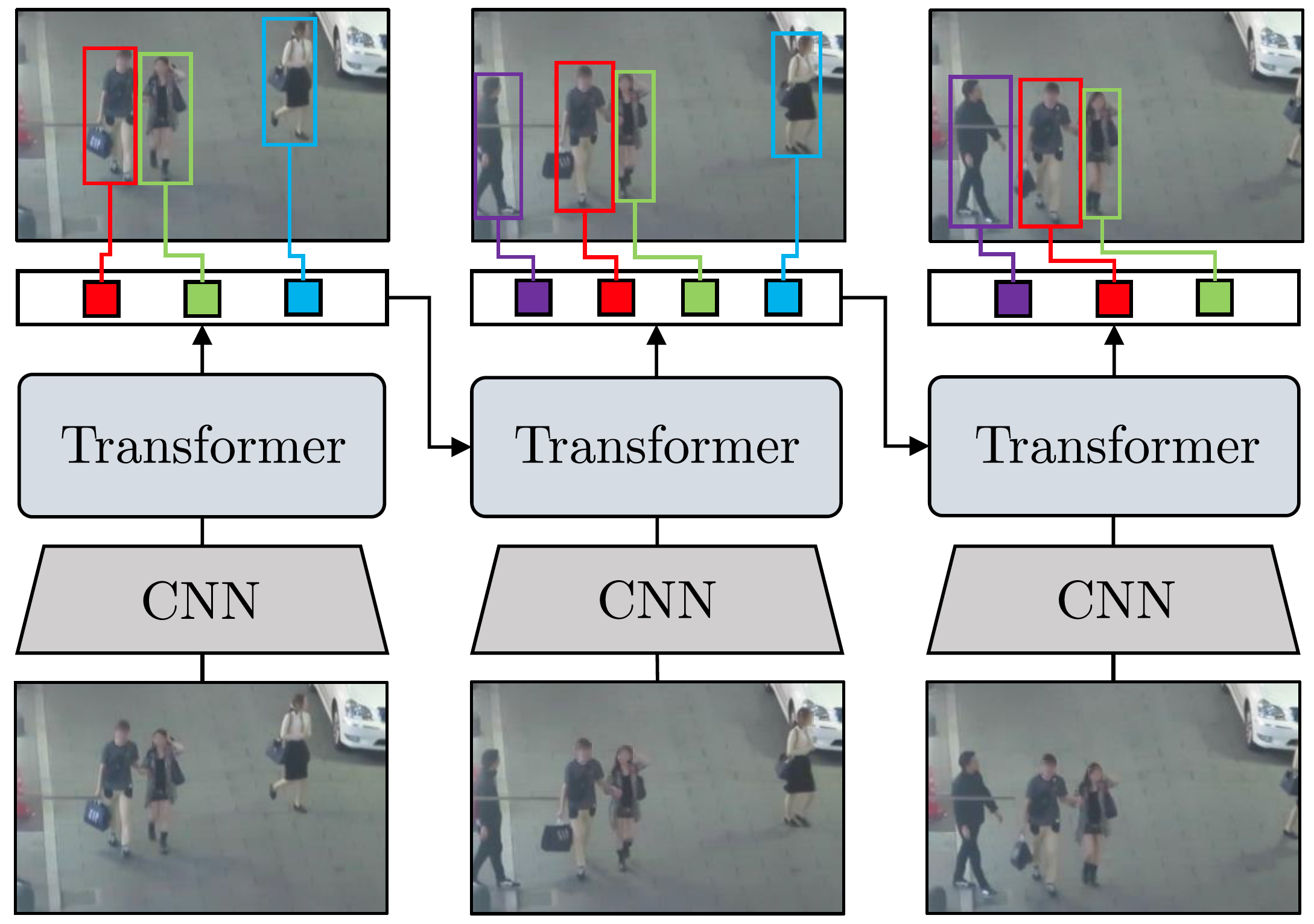
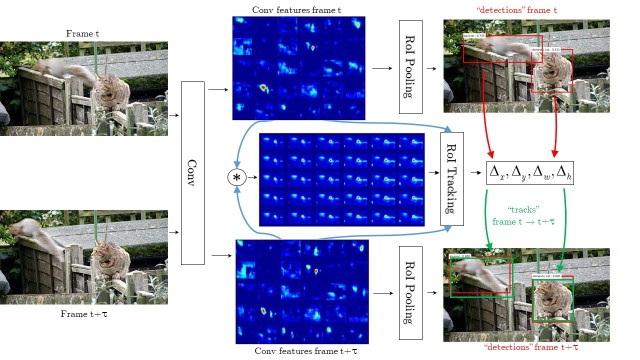
We present TrackFormer, an end-to-end multi-object tracking and segmentation model based on an encoder-decoder Transformer architecture. Our approach introduces track query embeddings which follow objects through a video sequence in an autoregressive fashion. New track queries are spawned by the DETR object detector and embed the position of their corresponding object over time. The Transformer decoder adjusts track query embeddings from frame to frame, thereby following the changing object positions. TrackFormer achieves a seamless data association between frames in a new tracking-by-attention paradigm by self- and encoder-decoder attention mechanisms which simultaneously reason about location, occlusion, and object identity. TrackFormer yields state-of-the-art performance on the tasks of multi-object tracking (MOT17) and segmentation (MOTS20). We hope our unified way of performing detection and tracking will foster future research in multi-object tracking and video understanding.


Ego4d: Around the world in 3,000 hours of egocentric video
Kristen Grauman et al.
Conference on Computer Vision and Pattern Recognition (CVPR) 2022 (Oral)
Best Paper Finalist
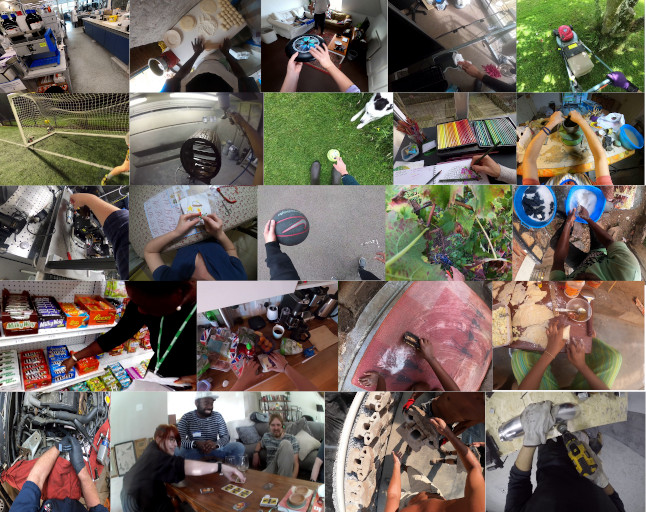
We introduce Ego4D, a massive-scale egocentric video dataset and benchmark suite. It offers 3,025 hours of daily-life activity video spanning hundreds of scenarios (household, outdoor, workplace, leisure, etc.) captured by 855 unique camera wearers from 74 worldwide locations and 9 different countries. The approach to collection is designed to uphold rigorous privacy and ethics standards with consenting participants and robust de-identification procedures where relevant. Ego4D dramatically expands the volume of diverse egocentric video footage publicly available to the research community. Portions of the video are accompanied by audio, 3D meshes of the environment, eye gaze, stereo, and/or synchronized videos from multiple egocentric cameras at the same event. Furthermore, we present a host of new benchmark challenges centered around understanding the first-person visual experience in the past (querying an episodic memory), present (analyzing hand-object manipulation, audio-visual conversation, and social interactions), and future (forecasting activities). By publicly sharing this massive annotated dataset and benchmark suite, we aim to push the frontier of first-person perception.


PyTorchVideo: A Deep Learning Library for Video Understanding
Haoqi Fan, Tullie Murrell, Heng Wang, Kalyan Vasudev Alwala, Yanghao Li, Yilei Li, Bo Xiong, Nikhila Ravi, Meng Li, Haichuan Yang, Jitendra Malik, Ross Girshick, Matt Feiszli, Aaron Adcock, Wan-Yen Lo, Christoph Feichtenhofer
Proceedings of the 29th ACM International Conference on Multimedia, 2021
We introduce PyTorchVideo, an open-source deep-learning library that provides a rich set of modular, efficient, and reproducible components for a variety of video understanding tasks, including classification, detection, self-supervised learning, and low-level processing. The library covers a full stack of video understanding tools including multimodal data loading, transformations, and models that reproduce state-of-the-art performance. PyTorchVideo further supports hardware acceleration that enables real-time inference on mobile devices. The library is based on PyTorch and can be used by any training framework; for example, PyTorchLightning, PySlowFast, or Classy Vision.


Multiscale Vision Transformers
Haoqi Fan*, Bo Xiong*, Karttikeya Mangalam*, Yanghao Li*, Zhicheng Yan, Jitendra Malik, Christoph Feichtenhofer*
*equal technical contribution
International Conference on Computer Vision (ICCV) 2021
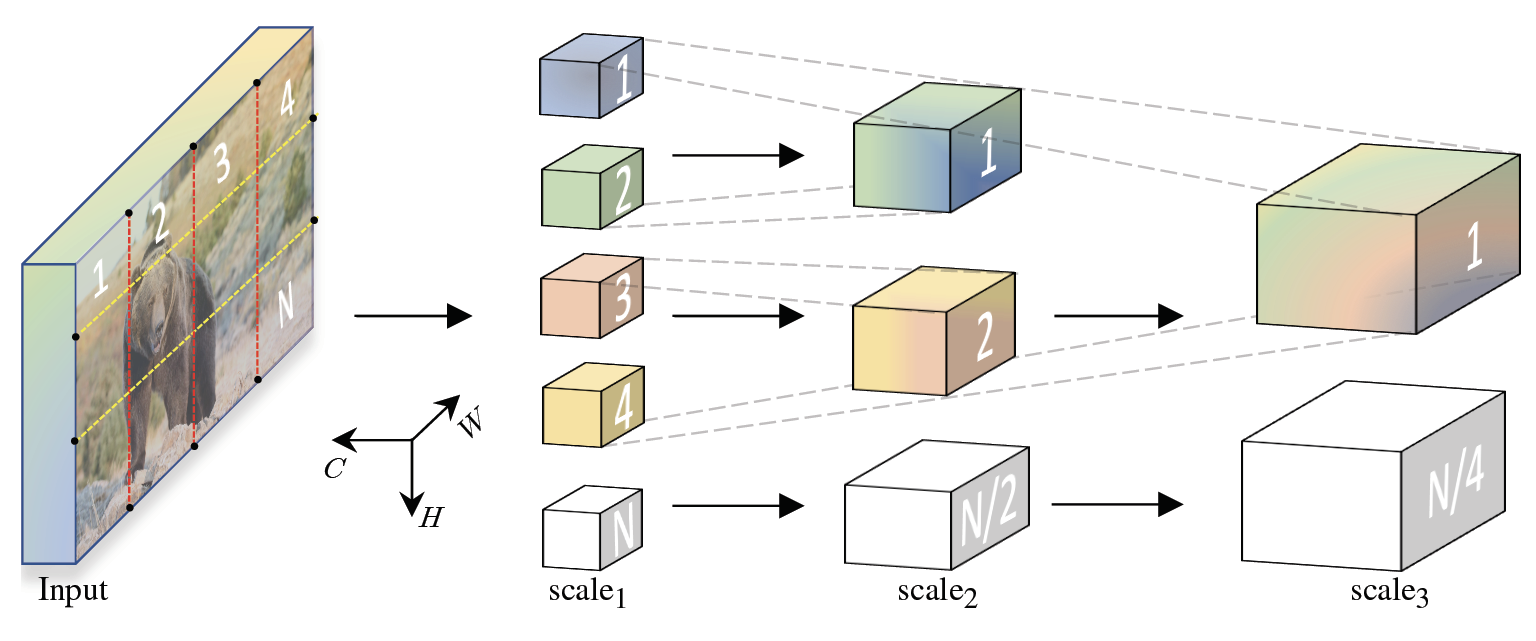
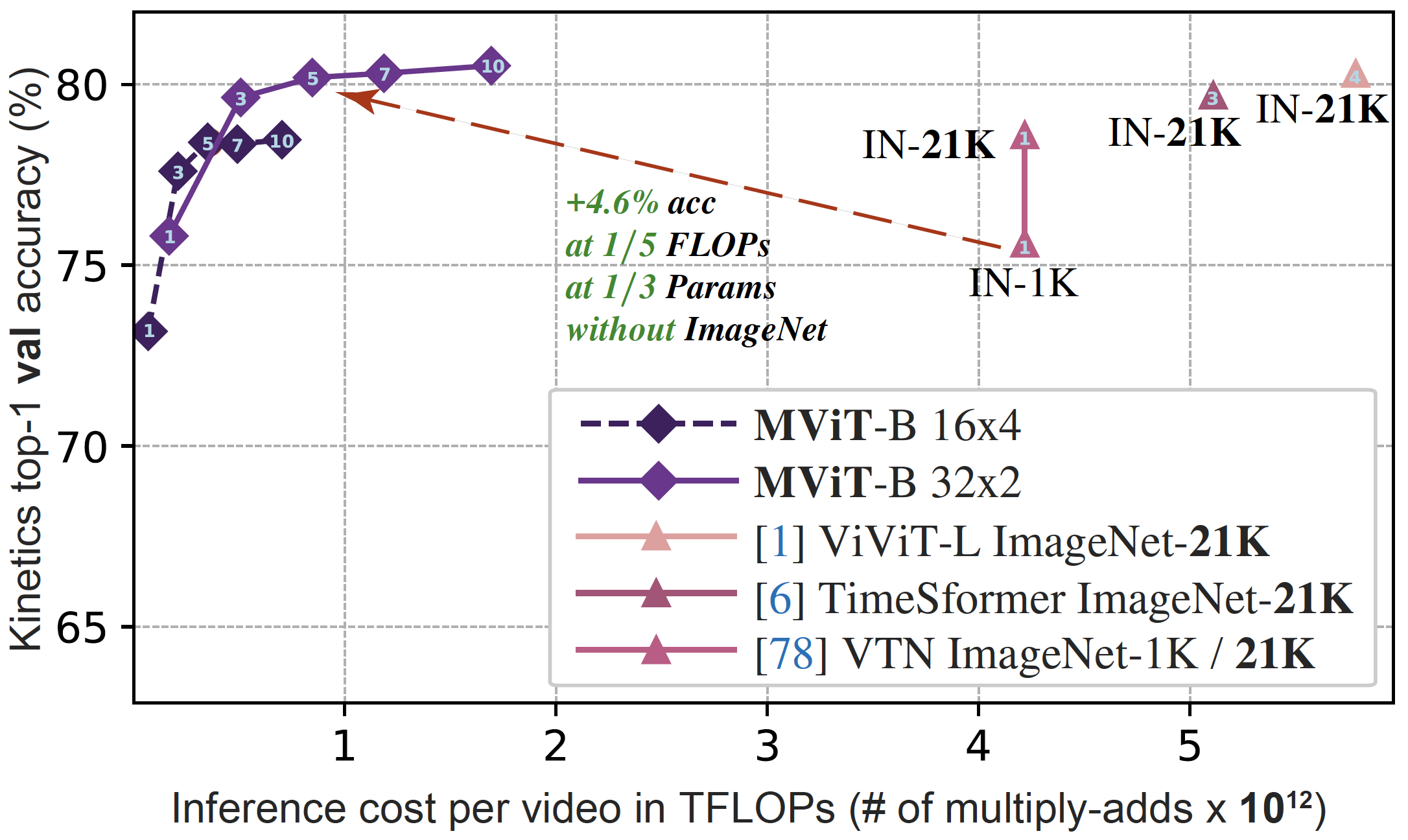
We present Multiscale Vision Transformers (MViT) for video and image recognition, by connecting the seminal idea of multiscale feature hierarchies with transformer models. Multiscale Transformers have several channel-resolution scale stages. Starting from the input resolution and a small channel dimension, the stages hierarchically expand the channel capacity while reducing the spatial resolution. This creates a multiscale pyramid of features with early layers operating at high spatial resolution to model simple low-level visual information, and deeper layers at spatially coarse, but complex, high-dimensional features. We evaluate this fundamental architectural prior for modeling the dense nature of visual signals for a variety of video recognition tasks where it outperforms concurrent vision transformers that rely on large scale external pre-training and are 5-10x more costly in computation and parameters. We further remove the temporal dimension and apply our model for image classification where it outperforms prior work on vision transformers.


A Large-Scale Study on Unsupervised Spatiotemporal Representation Learning
Christoph Feichtenhofer, Haoqi Fan, Bo Xiong, Ross Girshick, Kaiming He
Conference on Computer Vision and Pattern Recognition (CVPR) 2021
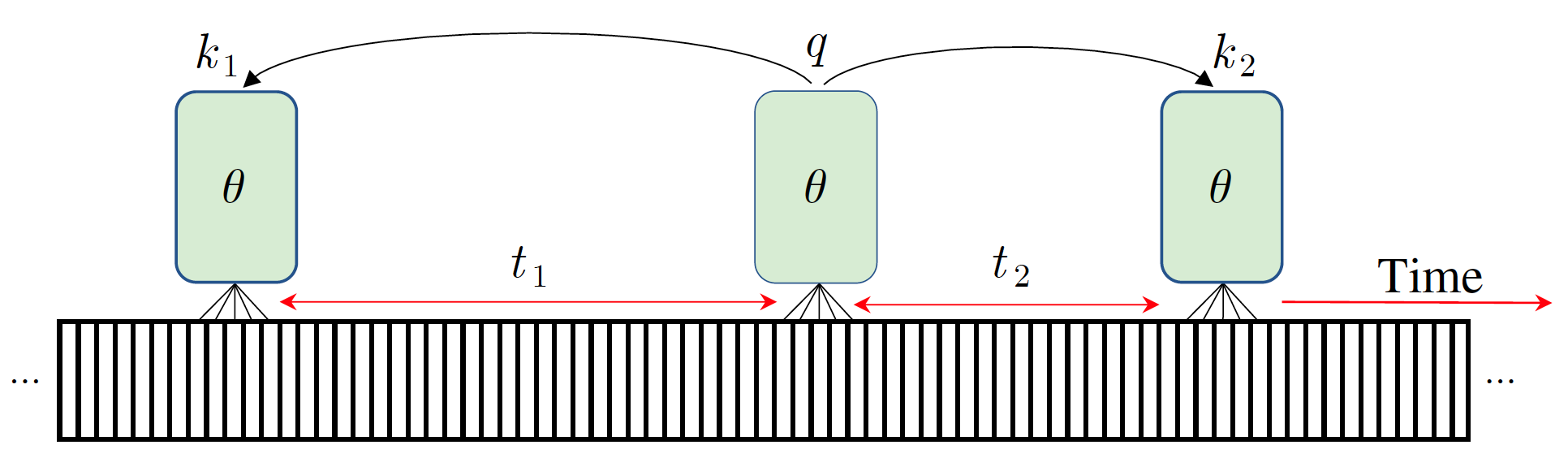
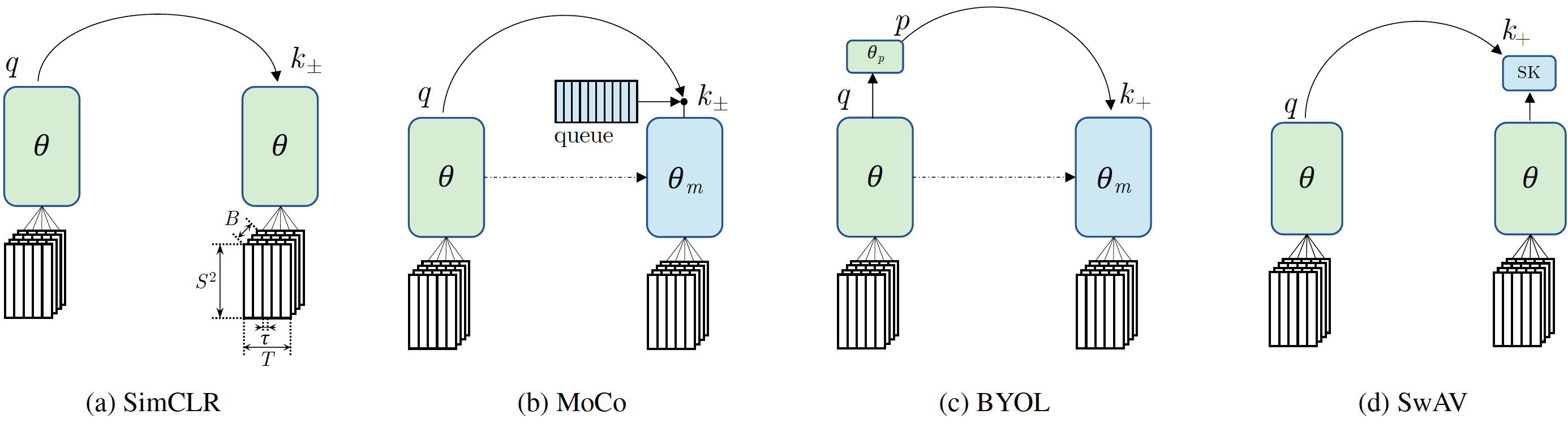
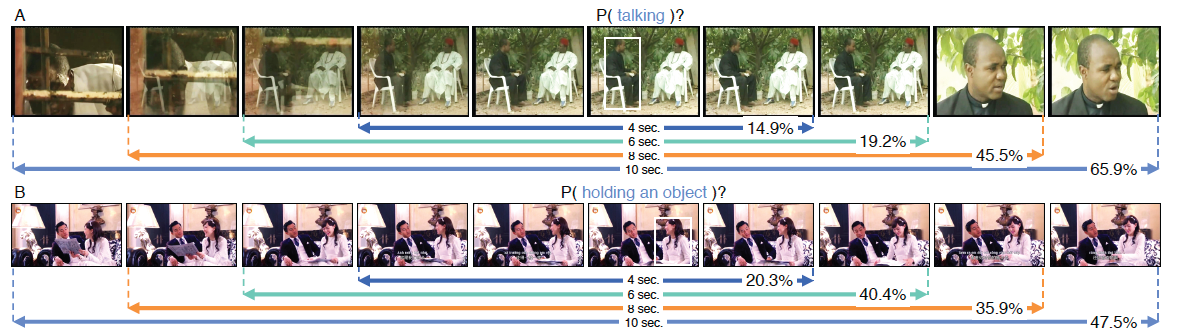
We present a large-scale study on unsupervised spatiotemporal representation learning from videos. With a unified perspective on four recent image-based frameworks, we study a simple objective that can easily generalize all these methods to space-time. Our objective encourages temporally-persistent features in the same video, and in spite of its simplicity, it works surprisingly well across: (i) different unsupervised frameworks, (ii) pre-training datasets, (iii) downstream datasets, and (iv) backbone architectures. We draw a series of intriguing observations from this study, e.g., we discover that encouraging long-spanned persistency can be effective even if the timespan is 60 seconds. In addition to state-of-the-art results in multiple benchmarks, we report a few promising cases in which unsupervised pre-training can outperform its supervised counterpart.
Show older publications ▼